Modèle de storyboard Combat / Power-up
Construire une séquence d'éveil ou de power-up style anime avant une contre-attaque décisive. Un modèle de storyboard de combat pour les scènes d'action anime.
À quoi sert ce modèle
Construire un éveil ou power-up style anime avant la contre-attaque.
Quand l'utiliser
Idéal pour
- séquences de combat
- moments de power-up
- scènes d'action anime
Structure de séquence à 9 panneaux
| # | Plan | Objectif | Caméra |
|---|---|---|---|
| 01 | Mise en place du champ de bataille | Établir l'environnement de combat | Plan large |
| 02 | Menace ennemie | Montrer la dominance ou le danger de l'ennemi | Plan moyen / contre-plongée |
| 03 | Héros blessé | Montrer le protagoniste en difficulté ou blessé | Gros plan / plan moyen |
| 04 | Déclencheur mémoriel | Introduire souvenir émotionnel, serment ou conviction | Insert / plan flashback |
| 05 | Éveil intérieur | Montrer le basculement ou la prise de conscience intérieure | Gros plan serré |
| 06 | Accumulation d'énergie | Visualiser la montée en puissance | Plan moyen dynamique |
| 07 | Révélation de la transformation | Révéler nouvelle forme, aura ou état de puissance | Révélation héroïque |
| 08 | Moment de contre-attaque | Montrer la première frappe décisive | Plan moyen large action |
| 09 | Pose de puissance épique | Terminer sur une pose iconique puissante | Plan final héroïque |
Établir l'environnement de combat
Montrer la dominance ou le danger de l'ennemi
Montrer le protagoniste en difficulté ou blessé
Introduire souvenir émotionnel, serment ou conviction
Montrer le basculement ou la prise de conscience intérieure
Visualiser la montée en puissance
Révéler nouvelle forme, aura ou état de puissance
Montrer la première frappe décisive
Terminer sur une pose iconique puissante
Votre histoire
Décrivez votre scène ou histoire en une phrase. Le prompt ci-dessous se met à jour en temps réel. Laissez vide pour utiliser l'exemple.
Aperçu du Prompt
Create a square 3x3 2048x2048 storyboard grid as a cinematic storyboard infographic showing build an anime-style awakening or power-up before counterattack: A wounded young warrior protects a broken village gate while the enemy army advances. A memory charm, inner resolve, rising energy, transformation, and first counterattack build the awakening beat by beat.

Use dark moody high-end film stills, realistic lighting, subtle teal-and-amber color grade, shallow depth of field, atmospheric dust and shadows. Maintain consistent subject identity, wardrobe, location type, visual medium, lighting, and color palette across all panels. If a reference image is provided, use it as the visual anchor for the subject, world, and style; if no reference image is provided, synthesize one coherent world from the story.

Plan the 9 storyboard panels yourself from the story and the template rhythm, then render the final infographic. Story facts must not change: preserve the named relationship, setting, key object, reveal, cause, and emotional meaning from the story. Do not replace the story's key object with a different document, incident, crime, accident, or backstory.

Arrange the storyboard in a clean 3x3 grid with thin black borders. Each tile must have a large crop-safe cinematic image area and a separate dark information strip below it. The image area must contain no text, labels, captions, UI, watermarks, or typography. Put all written information only in the strip below each image.

Sequence rhythm: Battlefield → enemy threat → hero wounded → memory trigger → inner awakening → energy build-up → transformation → counterattack → epic pose

Use this template structure as the shot grammar, but adapt every panel to the concrete story:
1. Battlefield setup (top-left) — Wide, 24mm. Purpose: Establish the combat environment. Suggested strip pattern: "SHOT 1 | ARRI Alexa Mini LF | 24mm | [write the concrete story beat you plan for this panel]"
2. Enemy threat (top-center) — Medium / low angle, 35mm. Purpose: Show the enemy's dominance or danger. Suggested strip pattern: "SHOT 2 | ARRI Alexa Mini LF | 35mm | [write the concrete story beat you plan for this panel]"
3. Hero wounded (top-right) — Close-up / medium, 75mm. Purpose: Show protagonist struggling or taking damage. Suggested strip pattern: "SHOT 3 | ARRI Alexa Mini LF | 75mm | [write the concrete story beat you plan for this panel]"
4. Memory trigger (middle-left) — Insert / flashback-style frame, 85mm. Purpose: Introduce emotional memory, vow, or belief. Suggested strip pattern: "SHOT 4 | ARRI Alexa Mini LF | 85mm | [write the concrete story beat you plan for this panel]"
5. Inner awakening (center) — Tight close-up, 75mm. Purpose: Show internal shift or realization. Suggested strip pattern: "SHOT 5 | ARRI Alexa Mini LF | 75mm | [write the concrete story beat you plan for this panel]"
6. Energy build-up (middle-right) — Dynamic medium, 35mm. Purpose: Visualize power gathering. Suggested strip pattern: "SHOT 6 | ARRI Alexa Mini LF | 35mm | [write the concrete story beat you plan for this panel]"
7. Transformation reveal (bottom-left) — Hero reveal, 35mm. Purpose: Reveal new form, aura, or power state. Suggested strip pattern: "SHOT 7 | ARRI Alexa Mini LF | 35mm | [write the concrete story beat you plan for this panel]"
8. Counterattack moment (bottom-center) — Action medium wide, 24mm. Purpose: Show first decisive strike or response. Suggested strip pattern: "SHOT 8 | ARRI Alexa Mini LF | 24mm | [write the concrete story beat you plan for this panel]"
9. Epic power pose (bottom-right) — Hero final frame, 35mm. Purpose: End on a powerful iconic pose. Suggested strip pattern: "SHOT 9 | ARRI Alexa Mini LF | 35mm | [write the concrete story beat you plan for this panel]"

Each information strip must show the planned panel title, shot metadata, and the concrete story beat in plain English. The strip text must include the story's key object and reveal where relevant, so the sequence cannot be mistaken for a different incident. Use clear numbered scene titles, compact metadata, and concise action subtitles in the information strips. Use plain text only: no emojis, no decorative symbols, no fake app UI text, and no real brand logos or copyrighted marks. Make each panel visually distinct through shot scale, camera angle, lens feeling, blocking, foreground/background layering, and subject movement. Exactly 9 panels, no extra panels, no merged panels, no duplicate compositions, no speech bubbles, no lorem ipsum, high-detail professional storyboard sheet.
Copiez le prompt et collez-le dans ChatGPT avec votre image de référence pour générer un storyboard. chatgpt.com →
Modèles similaires
 3×3
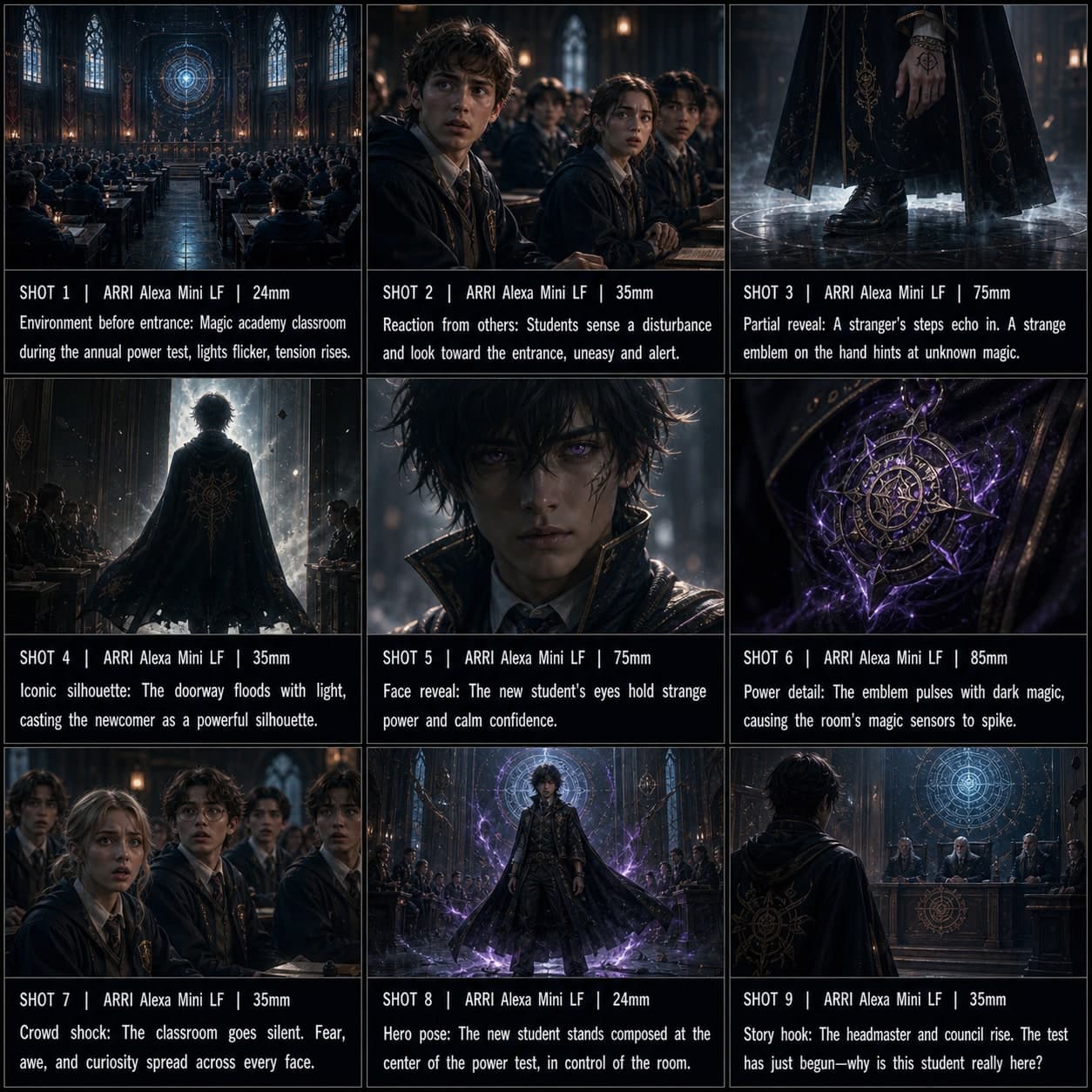
3×3Modèle de storyboard Entrée de personnage anime
Introduire un personnage avec une entrée dramatique style anime, des plans de réaction et une pose héros iconique. Un modèle de storyboard de personnage anime pour les visual novels.
 3×3
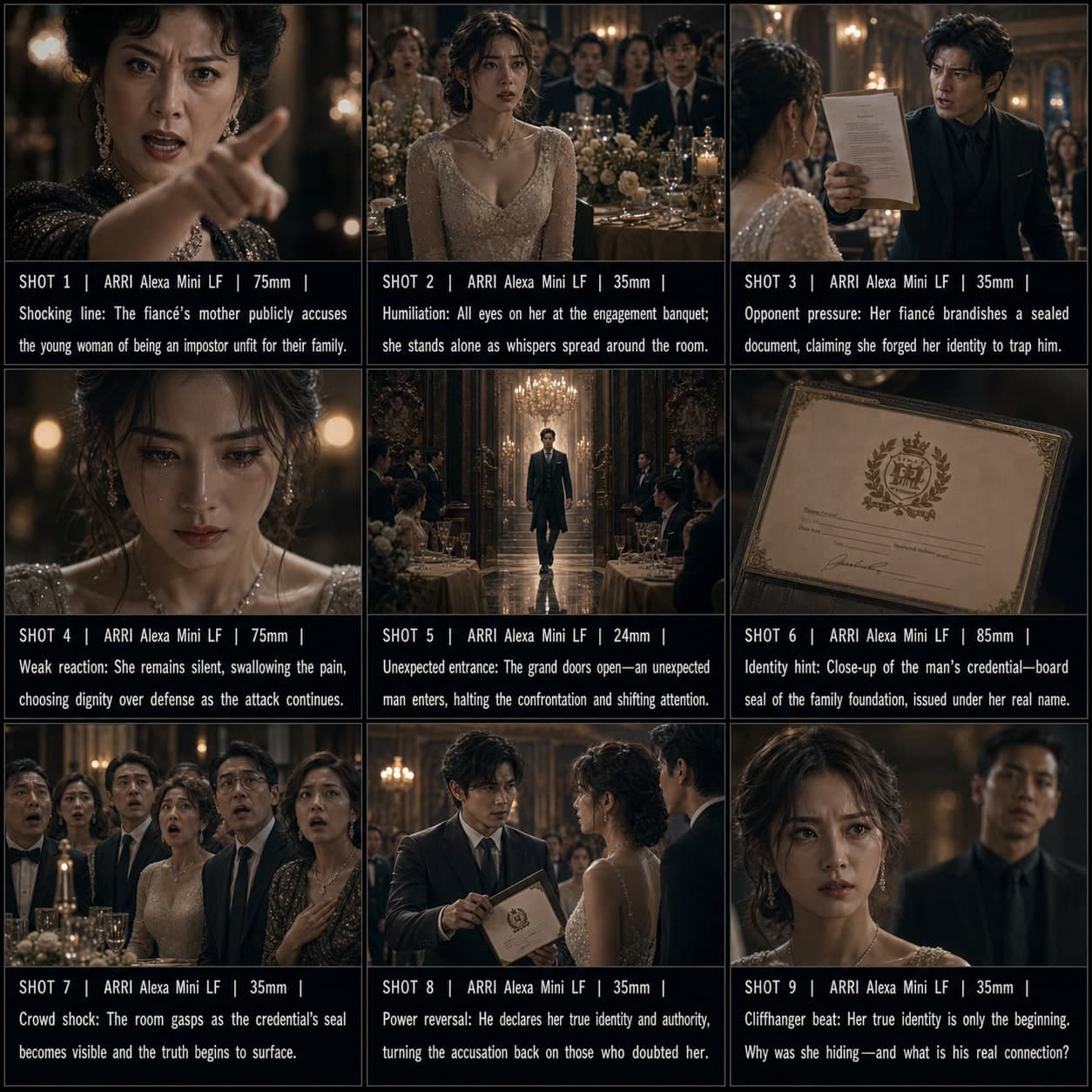
3×3Modèle de storyboard Accroche drama manhua
Créer une ouverture de court-métrage dramatique à haute tension avec une énergie de cliffhanger instantanée. Un modèle de storyboard drama manhua pour les séquences d'accroche de conflit.
 3×3
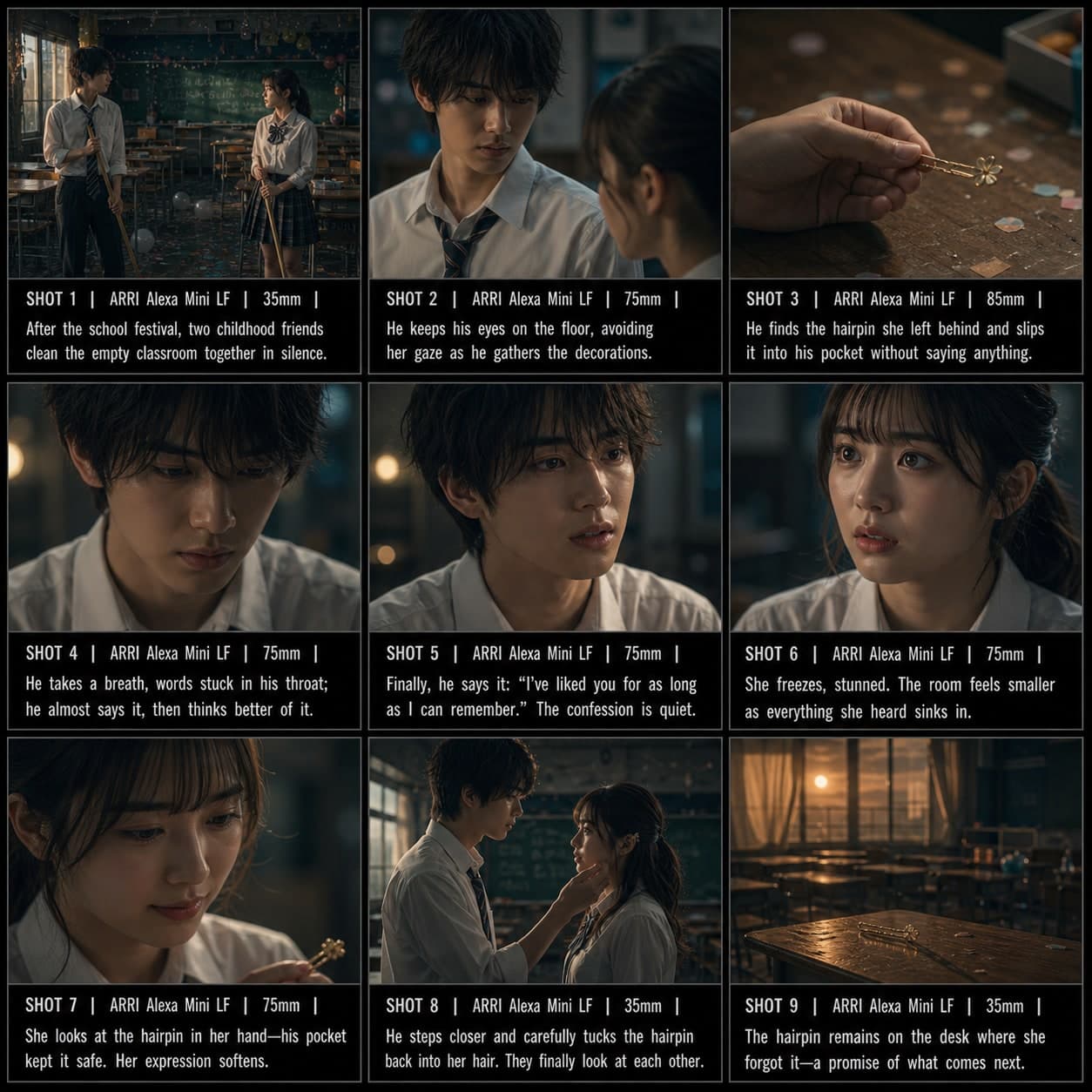
3×3Modèle de storyboard Confession romantique
Structurer une confession romantique avec hésitation, vulnérabilité et intimité émotionnelle. Un modèle de storyboard de confession romantique pour les scènes anime et drama.