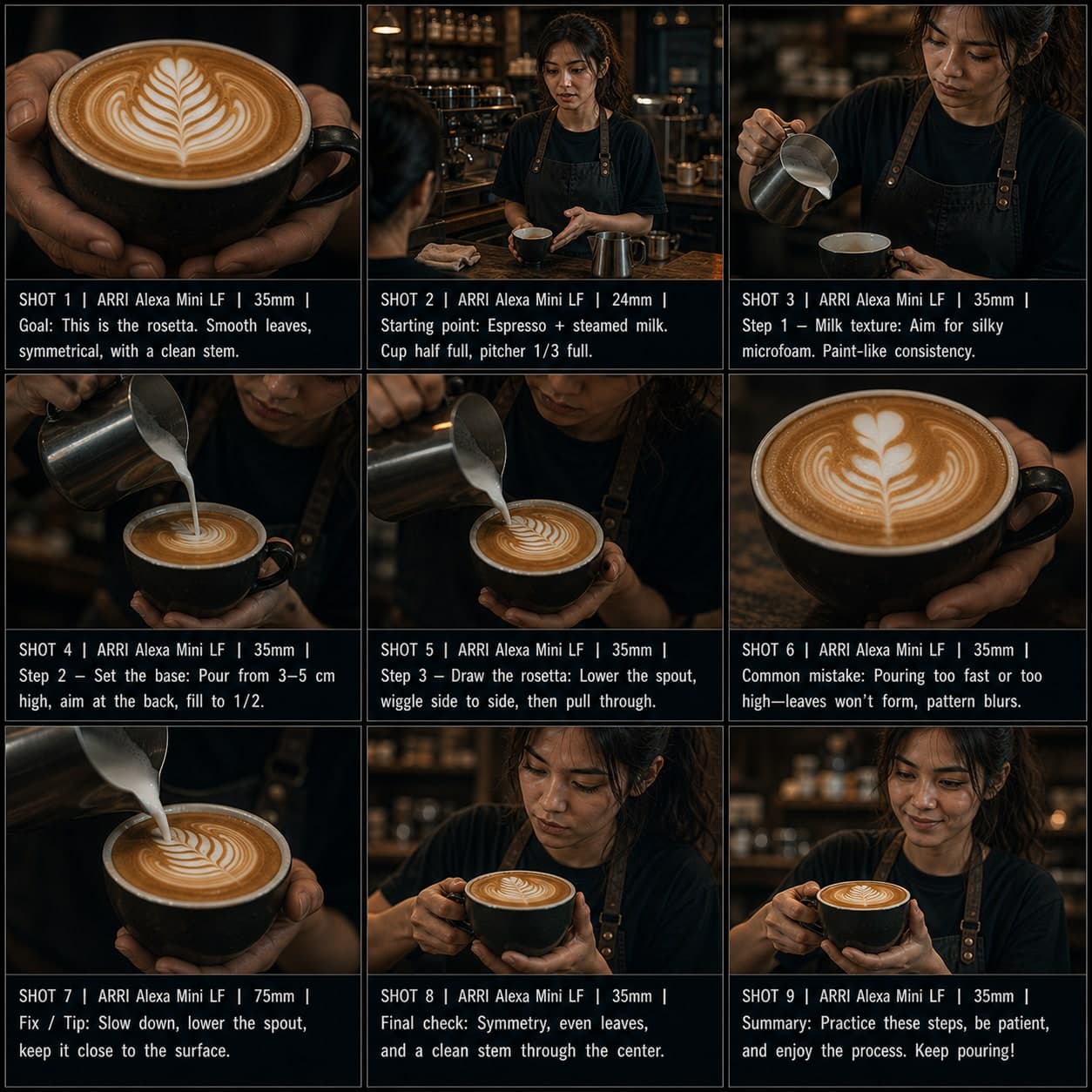
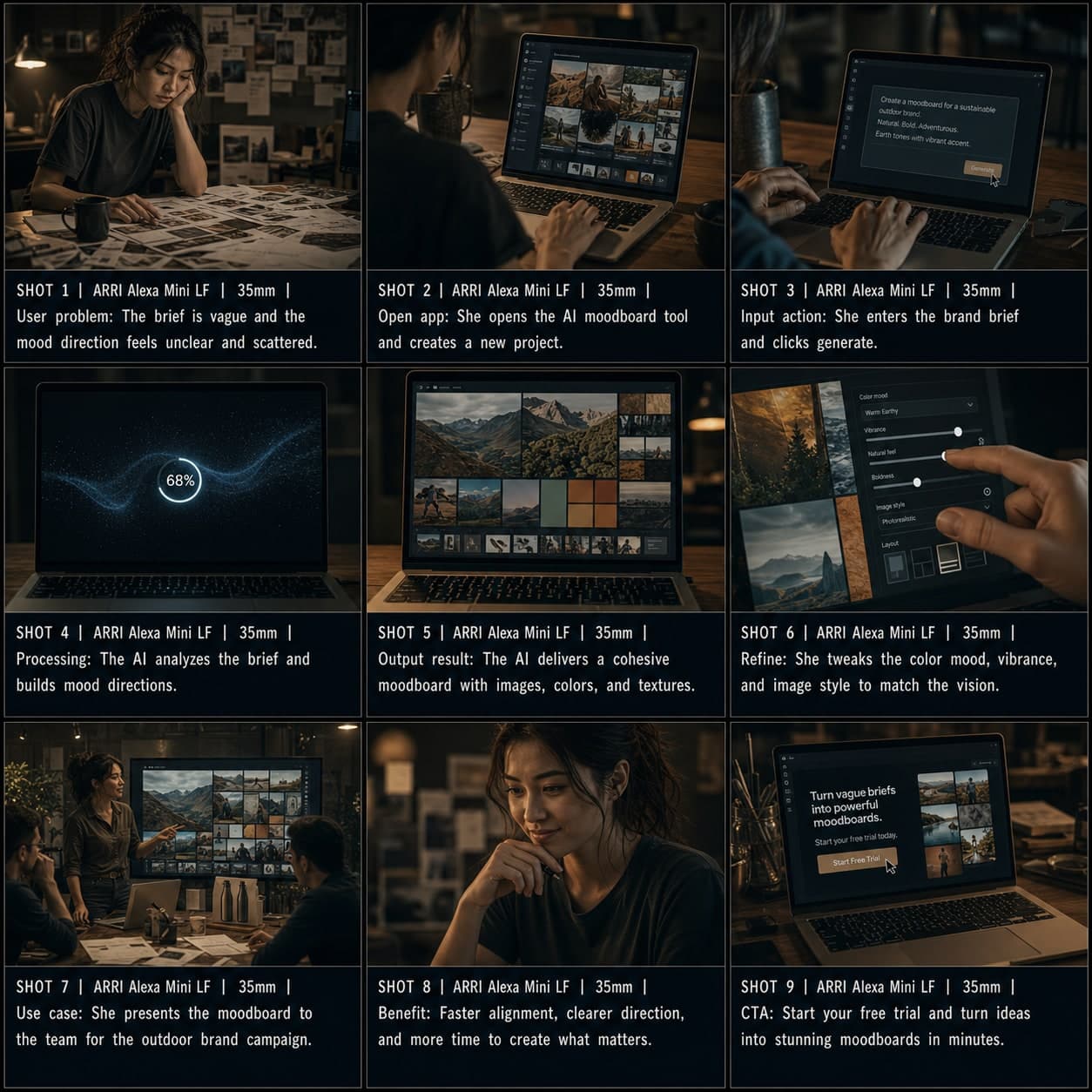
五镜头流程分镜模板
通过关键视觉覆盖展示制作过程——成果、手部、面部、背景、细节。适用于匠人内容的五镜头流程分镜模板。
这个模板的用途
通过关键视觉覆盖展示某人在做某事。
何时使用
适用于
- 过程记录
- 手工展示
- 匠人内容
9 格序列结构
| # | 镜头 | 目的 | 机位 |
|---|---|---|---|
| 01 | 成果预览 | 展示将要完成的东西 | 成果镜头 |
| 02 | 手部特写 | 展示正在做什么 | 手部特写 |
| 03 | 面部特写 | 展示谁在做 | 特写 |
| 04 | 全景背景 | 展示发生的地点 | 全景 |
| 05 | 过肩镜头 | 展示如何做 | 过肩 |
| 06 | 关键步骤细节 | 展示关键细节 | 插入镜头 |
| 07 | 问题或修正 | 展示困难或调整 | 中景 / 近景 |
| 08 | 完成动作 | 展示完成动作 | 动作镜头 |
| 09 | 最终成果 | 展示完成的结果 | 成果画面 |
01成果预览
展示将要完成的东西
成果镜头
02手部特写
展示正在做什么
手部特写
03面部特写
展示谁在做
特写
04全景背景
展示发生的地点
全景
05过肩镜头
展示如何做
过肩
06关键步骤细节
展示关键细节
插入镜头
07问题或修正
展示困难或调整
中景 / 近景
08完成动作
展示完成动作
动作镜头
09最终成果
展示完成的结果
成果画面
你的故事
用一句话描述你的场景或故事,下方 Prompt 会实时更新。留空则使用示例故事。
Prompt 预览
Create a square 3x3 2048x2048 storyboard grid as a cinematic storyboard infographic showing show someone doing something through essential visual coverage: A ceramic artist turns raw clay into a finished bowl. The sequence uses the classic process grammar: result preview, hands, face, workspace, over-the-shoulder action, key detail, correction, completion, and final object.

Use dark moody high-end film stills, realistic lighting, subtle teal-and-amber color grade, shallow depth of field, atmospheric dust and shadows. Maintain consistent subject identity, wardrobe, location type, visual medium, lighting, and color palette across all panels. If a reference image is provided, use it as the visual anchor for the subject, world, and style; if no reference image is provided, synthesize one coherent world from the story.

Plan the 9 storyboard panels yourself from the story and the template rhythm, then render the final infographic. Story facts must not change: preserve the named relationship, setting, key object, reveal, cause, and emotional meaning from the story. Do not replace the story's key object with a different document, incident, crime, accident, or backstory.

Arrange the storyboard in a clean 3x3 grid with thin black borders. Each tile must have a large crop-safe cinematic image area and a separate dark information strip below it. The image area must contain no text, labels, captions, UI, watermarks, or typography. Put all written information only in the strip below each image.

Sequence rhythm: Result preview → hands → face → wide context → OTS → detail → correction → completion → final result

Use this template structure as the shot grammar, but adapt every panel to the concrete story:
1. Result preview (top-left) — Result shot, 35mm. Purpose: Show what will be made or achieved. Suggested strip pattern: "SHOT 1 | ARRI Alexa Mini LF | 35mm | [write the concrete story beat you plan for this panel]"
2. Hands close-up (top-center) — Hands close-up, 75mm. Purpose: Show what is being done. Suggested strip pattern: "SHOT 2 | ARRI Alexa Mini LF | 75mm | [write the concrete story beat you plan for this panel]"
3. Face or subject close-up (top-right) — Close-up, 75mm. Purpose: Show who is doing it. Suggested strip pattern: "SHOT 3 | ARRI Alexa Mini LF | 75mm | [write the concrete story beat you plan for this panel]"
4. Wide context (middle-left) — Wide, 24mm. Purpose: Show where it happens. Suggested strip pattern: "SHOT 4 | ARRI Alexa Mini LF | 24mm | [write the concrete story beat you plan for this panel]"
5. Over-the-shoulder (center) — OTS, 50mm. Purpose: Show how it is done. Suggested strip pattern: "SHOT 5 | ARRI Alexa Mini LF | 50mm | [write the concrete story beat you plan for this panel]"
6. Key detail step (middle-right) — Insert, 85mm. Purpose: Show crucial detail. Suggested strip pattern: "SHOT 6 | ARRI Alexa Mini LF | 85mm | [write the concrete story beat you plan for this panel]"
7. Problem or correction (bottom-left) — Medium / close, 35mm. Purpose: Show difficulty or adjustment. Suggested strip pattern: "SHOT 7 | ARRI Alexa Mini LF | 35mm | [write the concrete story beat you plan for this panel]"
8. Completion action (bottom-center) — Action shot, 35mm. Purpose: Show finishing action. Suggested strip pattern: "SHOT 8 | ARRI Alexa Mini LF | 35mm | [write the concrete story beat you plan for this panel]"
9. Final result (bottom-right) — Result frame, 35mm. Purpose: Show completed outcome. Suggested strip pattern: "SHOT 9 | ARRI Alexa Mini LF | 35mm | [write the concrete story beat you plan for this panel]"

Each information strip must show the planned panel title, shot metadata, and the concrete story beat in plain English. The strip text must include the story's key object and reveal where relevant, so the sequence cannot be mistaken for a different incident. Use clear numbered scene titles, compact metadata, and concise action subtitles in the information strips. Use plain text only: no emojis, no decorative symbols, no fake app UI text, and no real brand logos or copyrighted marks. Make each panel visually distinct through shot scale, camera angle, lens feeling, blocking, foreground/background layering, and subject movement. Exactly 9 panels, no extra panels, no merged panels, no duplicate compositions, no speech bubbles, no lorem ipsum, high-detail professional storyboard sheet.
复制 Prompt 后,连同参考图粘贴到 ChatGPT 即可生成分镜表。 chatgpt.com →