Modello di storyboard Rivelazione di suspense
Costruire tensione verso una verità nascosta con pressione crescente e un finale ambiguo. Un modello di storyboard di suspense per scene thriller e mistero.
A cosa serve questo modello
Costruire tensione verso un indizio, una minaccia o una verità nascosta.
Quando usarlo
Ideale per
- scene thriller
- rivelazioni misteriose
- scoperta dell'orrore
Struttura di sequenza a 9 pannelli
| # | Inquadratura | Scopo | Camera |
|---|---|---|---|
| 01 | Situazione normale | Stabilire la realtà ordinaria | Campo lungo |
| 02 | Disagio sottile | Aggiungere una piccola perturbazione visiva | Piano medio |
| 03 | Dettaglio sospetto | Attirare l'attenzione su un dettaglio strano | Insert |
| 04 | Il personaggio nota | Mostrare la consapevolezza che si forma | Primo piano |
| 05 | Costruzione della tensione | Aumentare la pressione con inquadratura o ombra | Piano medio / dal basso |
| 06 | Rivelazione dell'indizio | Mostrare l'indizio chiave | Insert primo piano |
| 07 | Reazione di shock | Catturare l'impatto emotivo | Primo piano |
| 08 | Minaccia o conseguenza | Mostrare il pericolo o l'implicazione | Campo lungo / rivelazione |
| 09 | Fine irrisolta | Lasciare il pubblico in sospeso | Piano finale ambiguo |
Stabilire la realtà ordinaria
Aggiungere una piccola perturbazione visiva
Attirare l'attenzione su un dettaglio strano
Mostrare la consapevolezza che si forma
Aumentare la pressione con inquadratura o ombra
Mostrare l'indizio chiave
Catturare l'impatto emotivo
Mostrare il pericolo o l'implicazione
Lasciare il pubblico in sospeso
La tua storia
Descrivi la tua scena o storia in una frase. Il prompt sottostante si aggiorna in tempo reale. Lascia vuoto per usare l'esempio.
Anteprima Prompt
Create a square 3x3 2048x2048 storyboard grid as a cinematic storyboard infographic showing build tension toward a clue, threat, or hidden truth: A night security guard patrols a closed museum and finds a locked restoration room slightly open. Each clue suggests a break-in, until the final reveal shows someone has been secretly living behind the exhibits.

Use dark moody high-end film stills, realistic lighting, subtle teal-and-amber color grade, shallow depth of field, atmospheric dust and shadows. Maintain consistent subject identity, wardrobe, location type, visual medium, lighting, and color palette across all panels. If a reference image is provided, use it as the visual anchor for the subject, world, and style; if no reference image is provided, synthesize one coherent world from the story.

Plan the 9 storyboard panels yourself from the story and the template rhythm, then render the final infographic. Story facts must not change: preserve the named relationship, setting, key object, reveal, cause, and emotional meaning from the story. Do not replace the story's key object with a different document, incident, crime, accident, or backstory.

Arrange the storyboard in a clean 3x3 grid with thin black borders. Each tile must have a large crop-safe cinematic image area and a separate dark information strip below it. The image area must contain no text, labels, captions, UI, watermarks, or typography. Put all written information only in the strip below each image.

Sequence rhythm: Normal → unease → suspicious detail → awareness → tension → shock → unresolved

Use this template structure as the shot grammar, but adapt every panel to the concrete story:
1. Normal situation (top-left) — Wide, 24mm. Purpose: Establish ordinary reality. Suggested strip pattern: "SHOT 1 | ARRI Alexa Mini LF | 24mm | [write the concrete story beat you plan for this panel]"
2. Subtle unease (top-center) — Medium, 35mm. Purpose: Add a small visual disturbance. Suggested strip pattern: "SHOT 2 | ARRI Alexa Mini LF | 35mm | [write the concrete story beat you plan for this panel]"
3. Suspicious detail (top-right) — Insert, 85mm. Purpose: Focus attention on a strange detail. Suggested strip pattern: "SHOT 3 | ARRI Alexa Mini LF | 85mm | [write the concrete story beat you plan for this panel]"
4. Character notices (middle-left) — Close-up, 75mm. Purpose: Show awareness forming. Suggested strip pattern: "SHOT 4 | ARRI Alexa Mini LF | 75mm | [write the concrete story beat you plan for this panel]"
5. Tension build-up (center) — Medium / low angle, 35mm. Purpose: Increase pressure through framing or shadow. Suggested strip pattern: "SHOT 5 | ARRI Alexa Mini LF | 35mm | [write the concrete story beat you plan for this panel]"
6. Clue reveal (middle-right) — Insert close-up, 85mm. Purpose: Show the key clue. Suggested strip pattern: "SHOT 6 | ARRI Alexa Mini LF | 85mm | [write the concrete story beat you plan for this panel]"
7. Shock reaction (bottom-left) — Close-up, 75mm. Purpose: Capture the emotional hit. Suggested strip pattern: "SHOT 7 | ARRI Alexa Mini LF | 75mm | [write the concrete story beat you plan for this panel]"
8. Threat or consequence (bottom-center) — Wide / reveal shot, 24mm. Purpose: Show danger or implication. Suggested strip pattern: "SHOT 8 | ARRI Alexa Mini LF | 24mm | [write the concrete story beat you plan for this panel]"
9. Unresolved ending (bottom-right) — Ambiguous final frame, 35mm. Purpose: Leave the audience with suspense. Suggested strip pattern: "SHOT 9 | ARRI Alexa Mini LF | 35mm | [write the concrete story beat you plan for this panel]"

Each information strip must show the planned panel title, shot metadata, and the concrete story beat in plain English. The strip text must include the story's key object and reveal where relevant, so the sequence cannot be mistaken for a different incident. Use clear numbered scene titles, compact metadata, and concise action subtitles in the information strips. Use plain text only: no emojis, no decorative symbols, no fake app UI text, and no real brand logos or copyrighted marks. Make each panel visually distinct through shot scale, camera angle, lens feeling, blocking, foreground/background layering, and subject movement. Exactly 9 panels, no extra panels, no merged panels, no duplicate compositions, no speech bubbles, no lorem ipsum, high-detail professional storyboard sheet.
Copia il prompt e incollalo in ChatGPT insieme alla tua immagine di riferimento per generare uno storyboard. chatgpt.com →
Modelli correlati
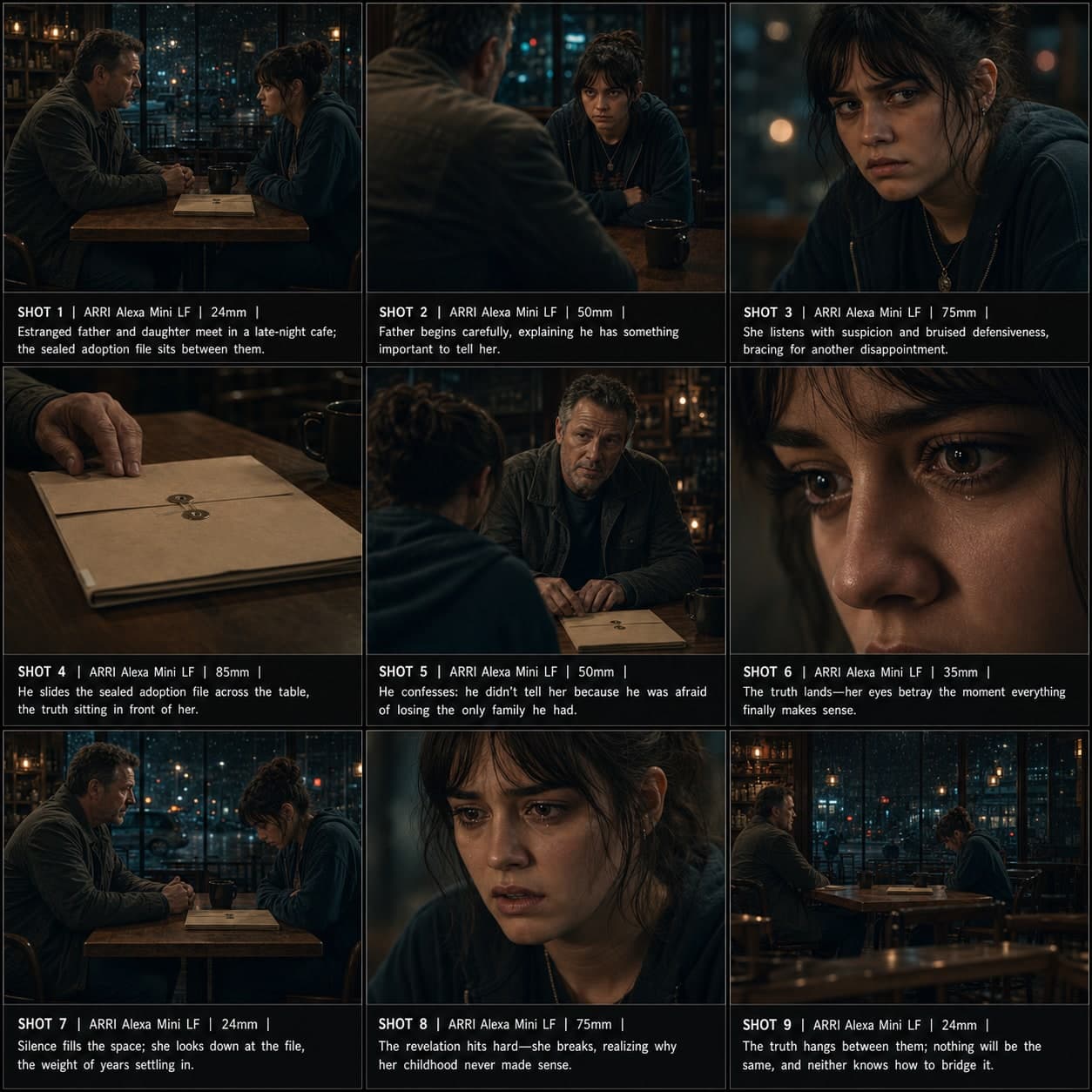 3×3
3×3Modello di storyboard Rivelazione nel dialogo
Una sequenza di 9 pannelli per rivelare una verità difficile attraverso conversazione, reazione e silenzio. Ideale per il dramma basato sul dialogo.
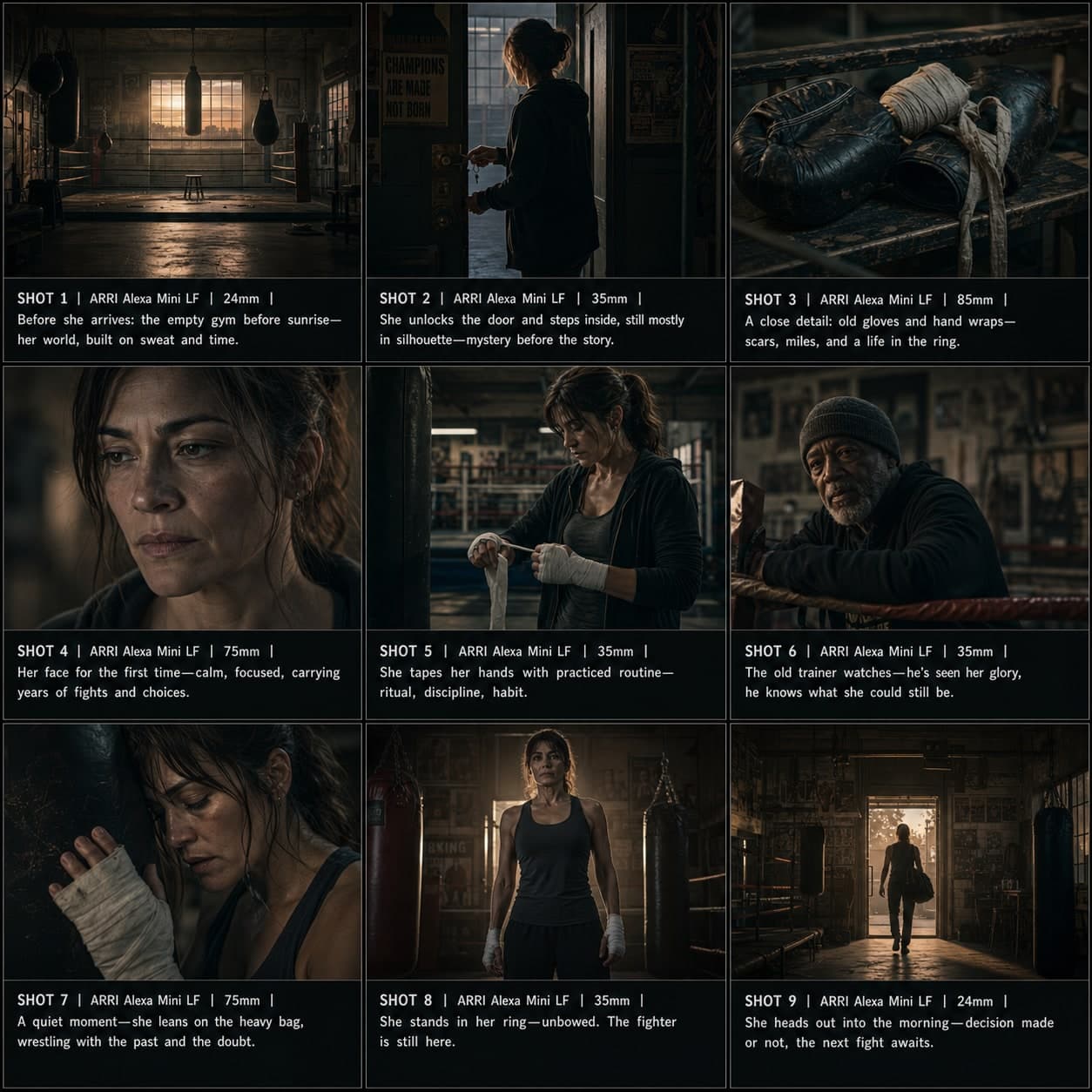 3×3
3×3Modello di storyboard Introduzione del personaggio
Introdurre un personaggio attraverso ambiente, dettaglio, azione e un'iconica inquadratura hero. Un modello di storyboard di introduzione del personaggio per cinema e narrazione.
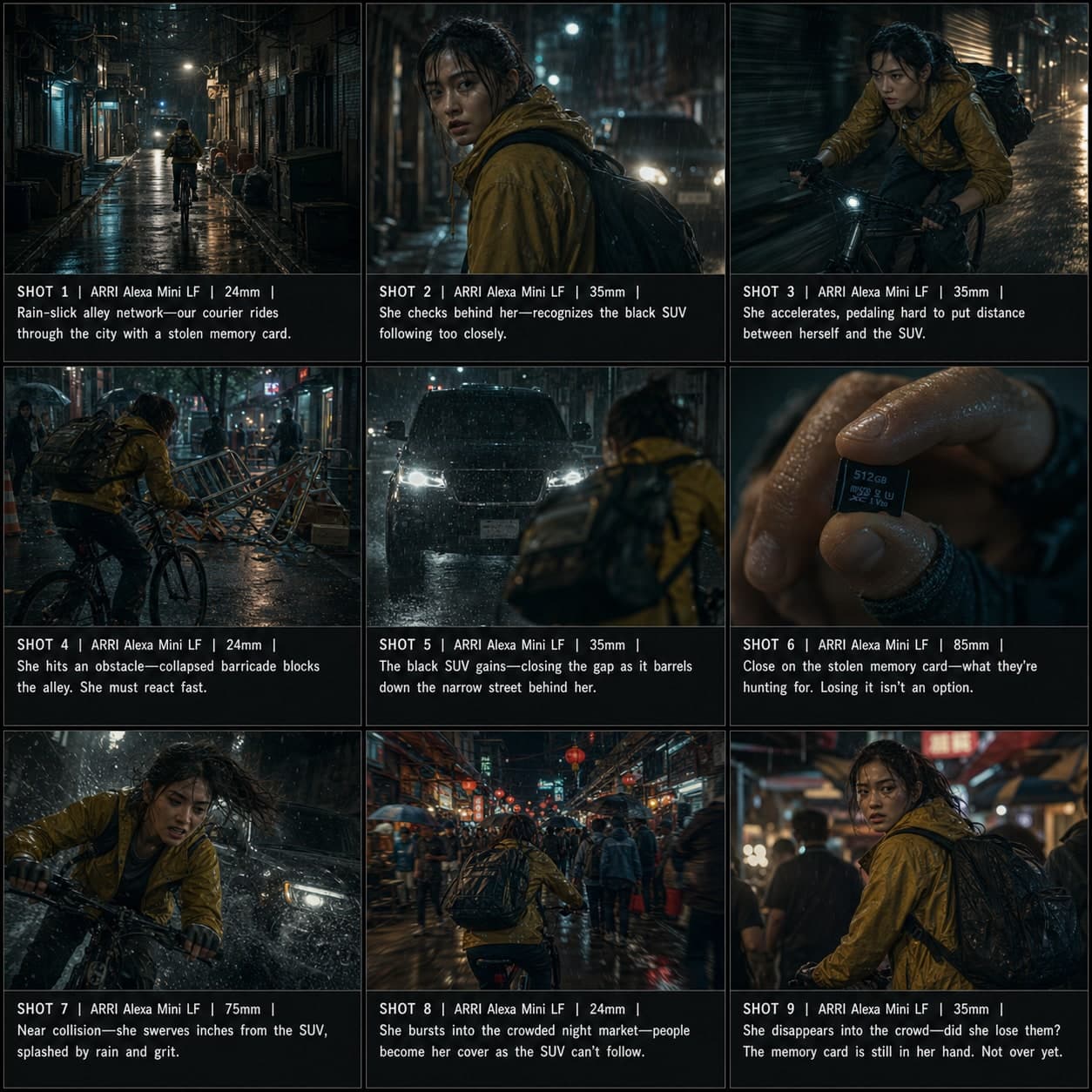 3×3
3×3Modello di storyboard Azione / Inseguimento
Costruire una sequenza di inseguimento fisico dalla configurazione spaziale attraverso ostacoli, inseguimento e fuga. Un modello di storyboard d'azione per scene di inseguimento.
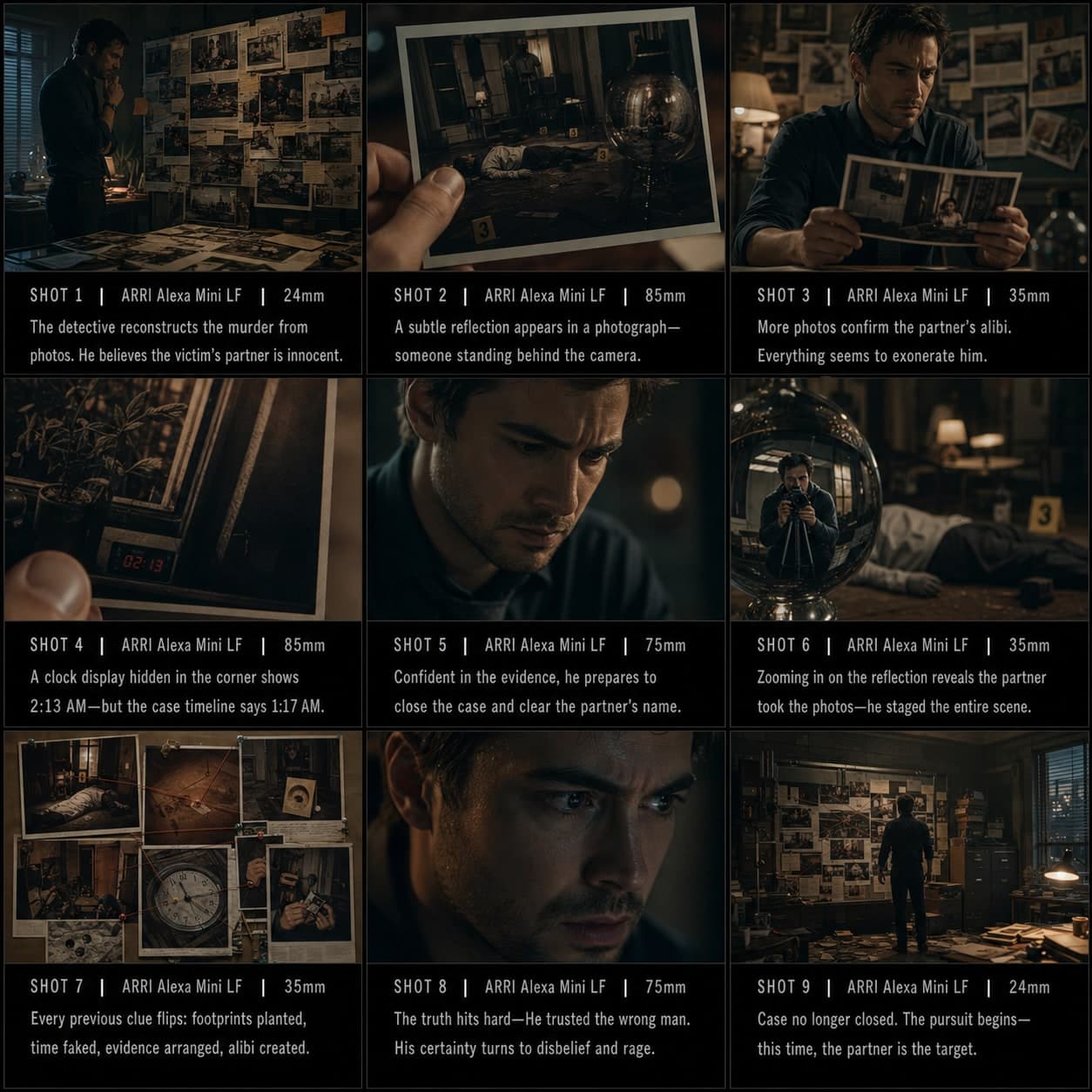 3×3
3×3Modello di storyboard Rivelazione del colpo di scena
Piazzare indizi sotto una falsa ipotesi, poi ricontestualizzare tutto con un colpo di scena drammatico. Un modello di storyboard mistero a 9 pannelli per thriller e suspense.