Modèle de storyboard Introduction de personnage
Introduire un personnage par l'environnement, le détail, l'action et un plan héros iconique. Un modèle de storyboard d'introduction de personnage pour le cinéma et la narration.
À quoi sert ce modèle
Introduire un personnage par l'environnement, le détail, l'action et la présence.
Quand l'utiliser
Idéal pour
- introductions de personnages
- révélations de protagonistes
- moments d'origine
Structure de séquence à 9 panneaux
| # | Plan | Objectif | Caméra |
|---|---|---|---|
| 01 | Environnement avant le sujet | Établir le monde avant l'apparition du personnage | Plan large |
| 02 | Silhouette ou révélation partielle | Introduire le mystère | Révélation partielle |
| 03 | Détail costume ou objet | Suggérer l'identité | Insert |
| 04 | Premier visage clair | Révéler le personnage | Gros plan |
| 05 | Habitude d'action | Montrer un comportement ou une routine | Plan moyen |
| 06 | Réaction des autres | Montrer comment le monde le perçoit | Plan réaction |
| 07 | Beat force ou vulnérabilité | Révéler le trait définissant | Plan moyen gros plan |
| 08 | Pose iconique | Créer une image mémorable | Plan héroïque |
| 09 | Indice de direction | Suggérer où le personnage se dirige | Plan large / directionnel |
Établir le monde avant l'apparition du personnage
Introduire le mystère
Suggérer l'identité
Révéler le personnage
Montrer un comportement ou une routine
Montrer comment le monde le perçoit
Révéler le trait définissant
Créer une image mémorable
Suggérer où le personnage se dirige
Votre histoire
Décrivez votre scène ou histoire en une phrase. Le prompt ci-dessous se met à jour en temps réel. Laissez vide pour utiliser l'exemple.
Aperçu du Prompt
Create a square 3x3 2048x2048 storyboard grid as a cinematic storyboard infographic showing introduce a character through environment, detail, action, and presence: A retired boxer unlocks her small gym before sunrise. The sequence introduces her through the empty ring, taped hands, worn heavy bag, and the calm face of someone deciding whether to fight again.

Use dark moody high-end film stills, realistic lighting, subtle teal-and-amber color grade, shallow depth of field, atmospheric dust and shadows. Maintain consistent subject identity, wardrobe, location type, visual medium, lighting, and color palette across all panels. If a reference image is provided, use it as the visual anchor for the subject, world, and style; if no reference image is provided, synthesize one coherent world from the story.

Plan the 9 storyboard panels yourself from the story and the template rhythm, then render the final infographic. Story facts must not change: preserve the named relationship, setting, key object, reveal, cause, and emotional meaning from the story. Do not replace the story's key object with a different document, incident, crime, accident, or backstory.

Arrange the storyboard in a clean 3x3 grid with thin black borders. Each tile must have a large crop-safe cinematic image area and a separate dark information strip below it. The image area must contain no text, labels, captions, UI, watermarks, or typography. Put all written information only in the strip below each image.

Sequence rhythm: Environment → partial reveal → detail → face → action → reaction → hero shot

Use this template structure as the shot grammar, but adapt every panel to the concrete story:
1. Environment before subject (top-left) — Wide, 24mm. Purpose: Establish the world before the character appears. Suggested strip pattern: "SHOT 1 | ARRI Alexa Mini LF | 24mm | [write the concrete story beat you plan for this panel]"
2. Silhouette or partial reveal (top-center) — Partial reveal, 35mm. Purpose: Introduce mystery. Suggested strip pattern: "SHOT 2 | ARRI Alexa Mini LF | 35mm | [write the concrete story beat you plan for this panel]"
3. Costume or object detail (top-right) — Insert, 85mm. Purpose: Hint at identity. Suggested strip pattern: "SHOT 3 | ARRI Alexa Mini LF | 85mm | [write the concrete story beat you plan for this panel]"
4. First clear face (middle-left) — Close-up, 75mm. Purpose: Reveal the character. Suggested strip pattern: "SHOT 4 | ARRI Alexa Mini LF | 75mm | [write the concrete story beat you plan for this panel]"
5. Action habit (center) — Medium, 35mm. Purpose: Show behavior or routine. Suggested strip pattern: "SHOT 5 | ARRI Alexa Mini LF | 35mm | [write the concrete story beat you plan for this panel]"
6. Reaction from others (middle-right) — Reaction shot, 35mm. Purpose: Show how the world sees them. Suggested strip pattern: "SHOT 6 | ARRI Alexa Mini LF | 35mm | [write the concrete story beat you plan for this panel]"
7. Power or vulnerability beat (bottom-left) — Medium close-up, 75mm. Purpose: Reveal defining trait. Suggested strip pattern: "SHOT 7 | ARRI Alexa Mini LF | 75mm | [write the concrete story beat you plan for this panel]"
8. Iconic pose (bottom-center) — Hero shot, 35mm. Purpose: Create memorable image. Suggested strip pattern: "SHOT 8 | ARRI Alexa Mini LF | 35mm | [write the concrete story beat you plan for this panel]"
9. Story direction hint (bottom-right) — Wide / directional frame, 24mm. Purpose: Suggest where the character is headed. Suggested strip pattern: "SHOT 9 | ARRI Alexa Mini LF | 24mm | [write the concrete story beat you plan for this panel]"

Each information strip must show the planned panel title, shot metadata, and the concrete story beat in plain English. The strip text must include the story's key object and reveal where relevant, so the sequence cannot be mistaken for a different incident. Use clear numbered scene titles, compact metadata, and concise action subtitles in the information strips. Use plain text only: no emojis, no decorative symbols, no fake app UI text, and no real brand logos or copyrighted marks. Make each panel visually distinct through shot scale, camera angle, lens feeling, blocking, foreground/background layering, and subject movement. Exactly 9 panels, no extra panels, no merged panels, no duplicate compositions, no speech bubbles, no lorem ipsum, high-detail professional storyboard sheet.
Copiez le prompt et collez-le dans ChatGPT avec votre image de référence pour générer un storyboard. chatgpt.com →
Modèles similaires
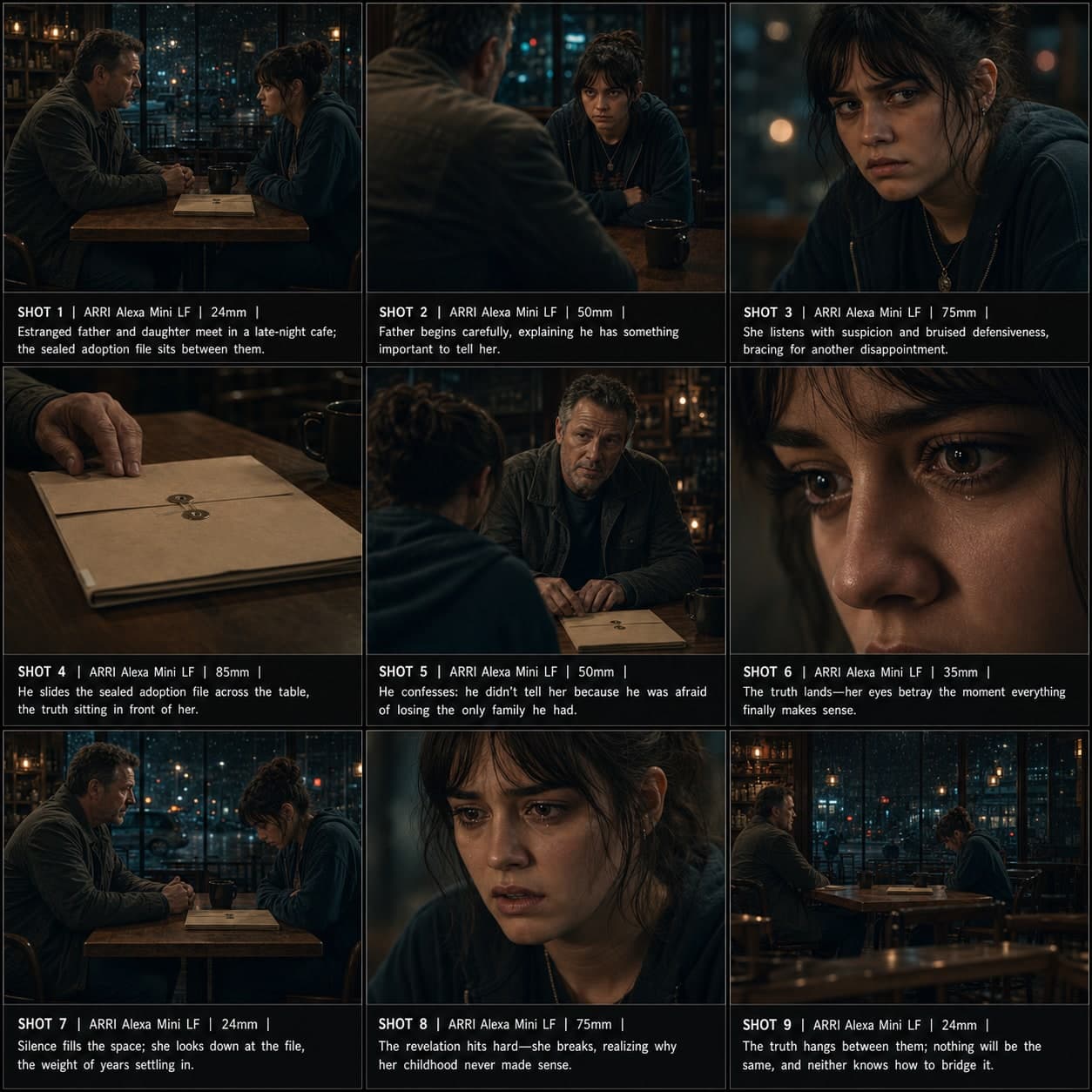 3×3
3×3Modèle de storyboard Révélation par le dialogue
Une séquence de 9 panneaux pour révéler une vérité difficile à travers la conversation, la réaction et le silence. Idéal pour le drame basé sur le dialogue.
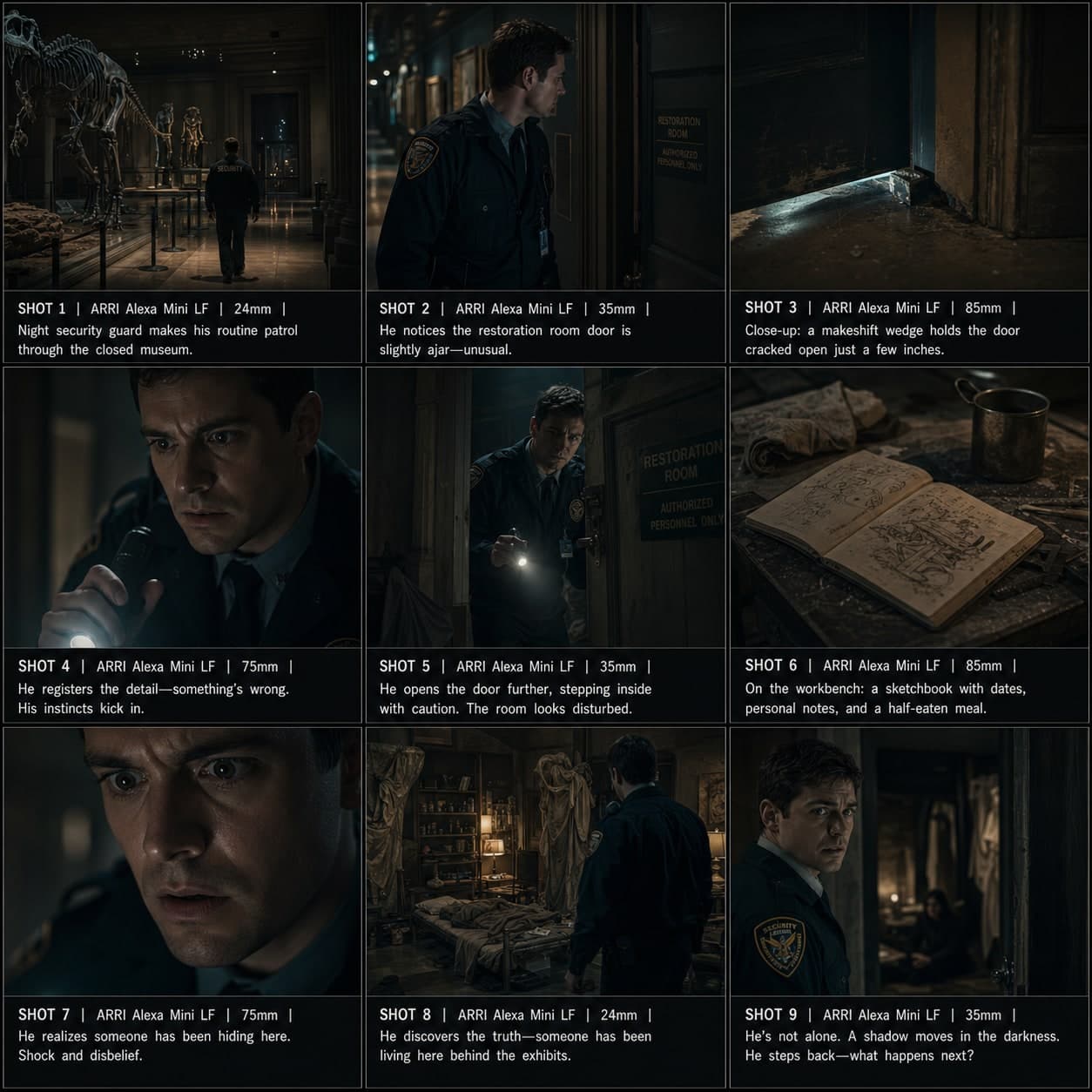 3×3
3×3Modèle de storyboard Révélation de suspense
Construire la tension vers une vérité cachée avec une pression croissante et une fin ambiguë. Un modèle de storyboard de suspense pour les scènes de thriller et de mystère.
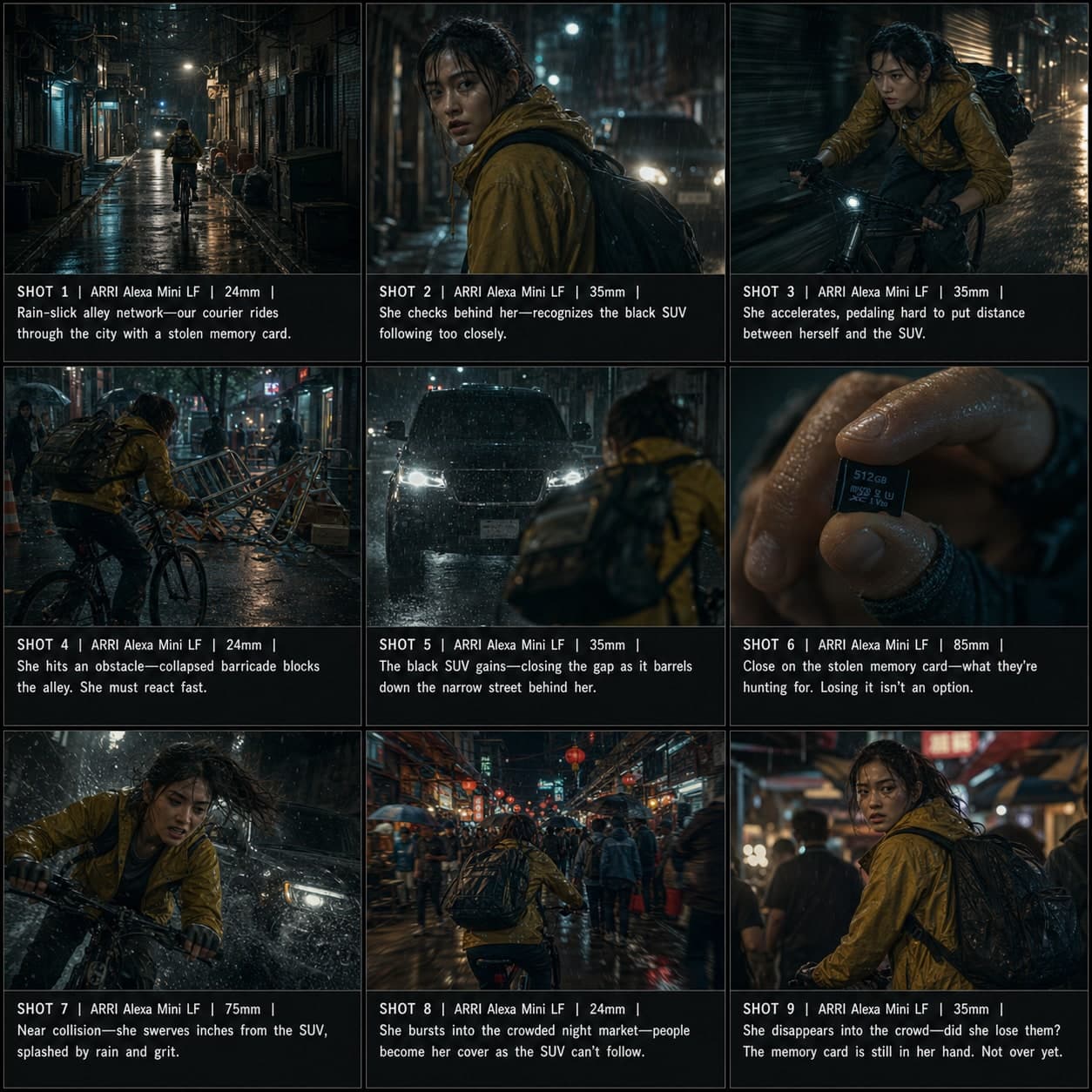 3×3
3×3Modèle de storyboard Action / Poursuite
Construire une séquence de poursuite physique depuis la mise en place spatiale jusqu'à l'obstacle, la poursuite et l'évasion. Un modèle de storyboard d'action pour les scènes de poursuite.
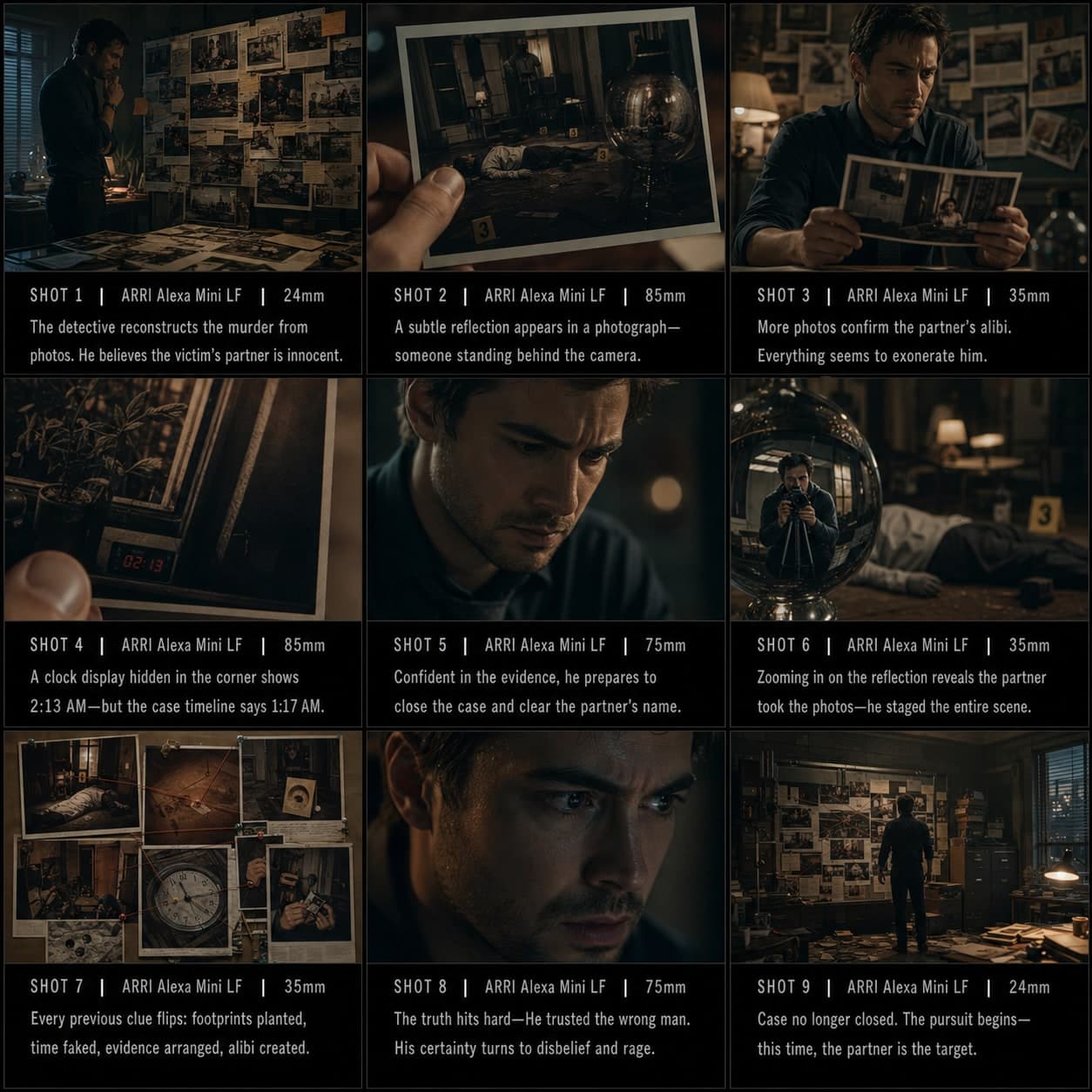 3×3
3×3Modèle de storyboard Révélation de retournement
Placer des indices sous une fausse hypothèse, puis tout recontextualiser avec un retournement dramatique. Un modèle de storyboard mystère à 9 panneaux pour les thrillers et le suspense.