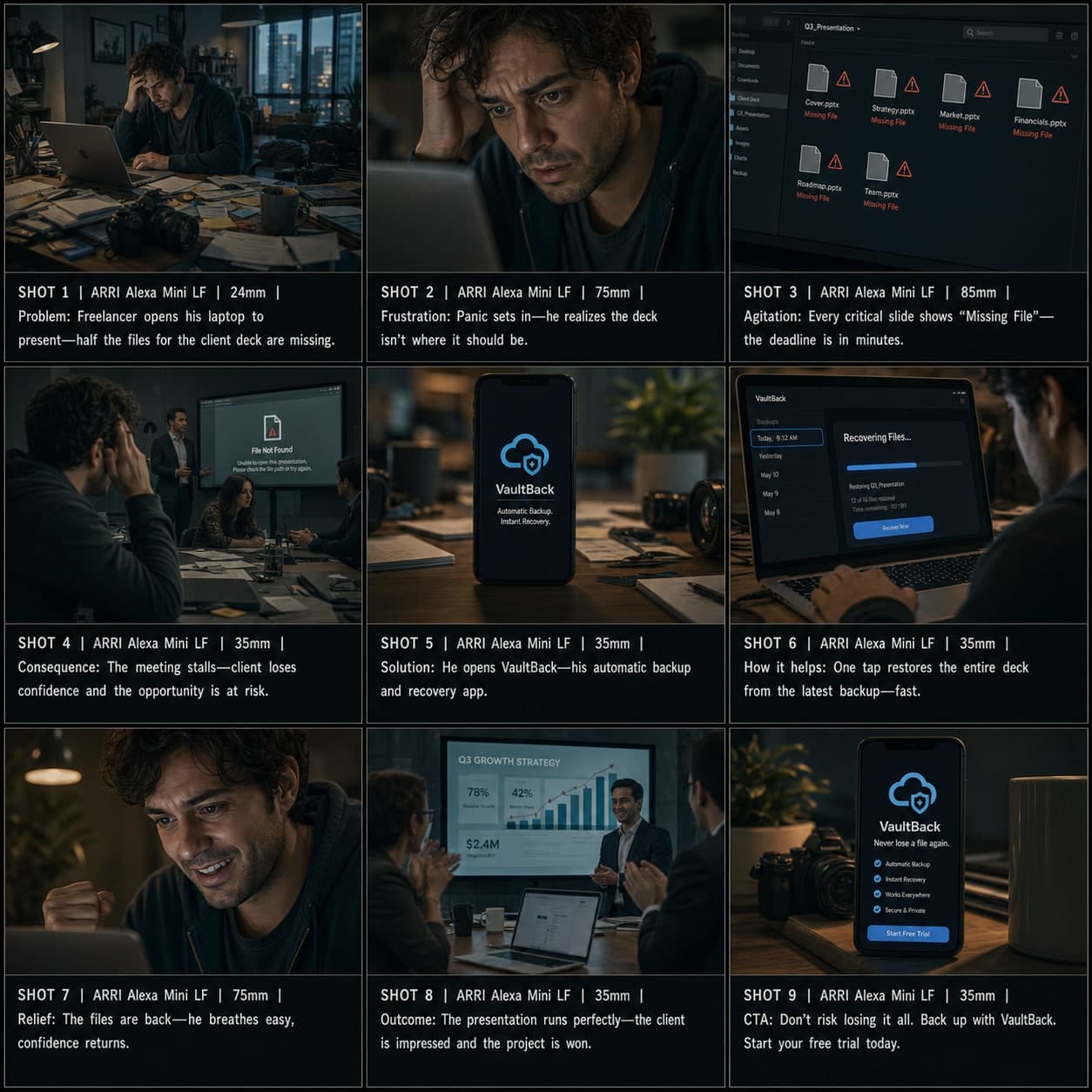
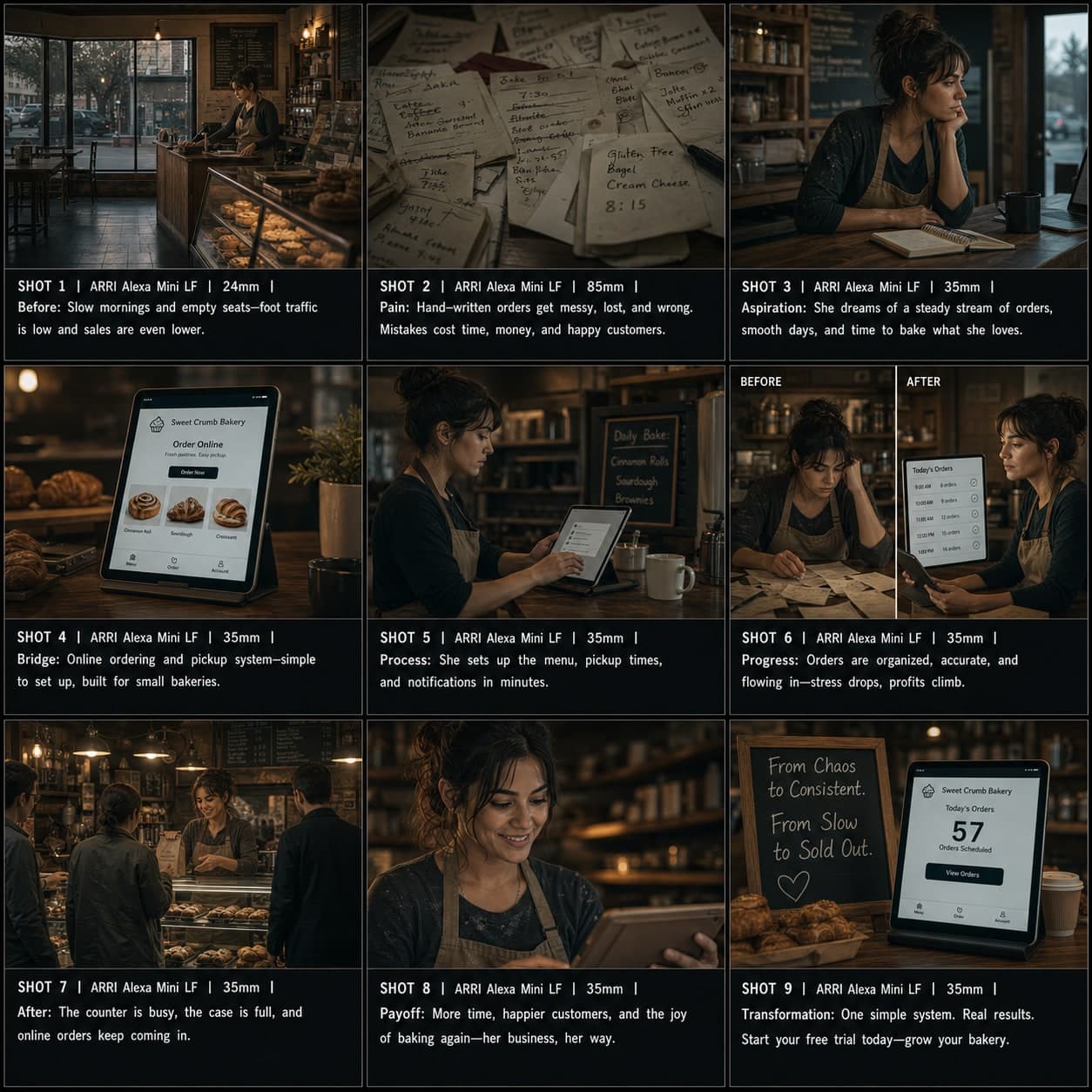
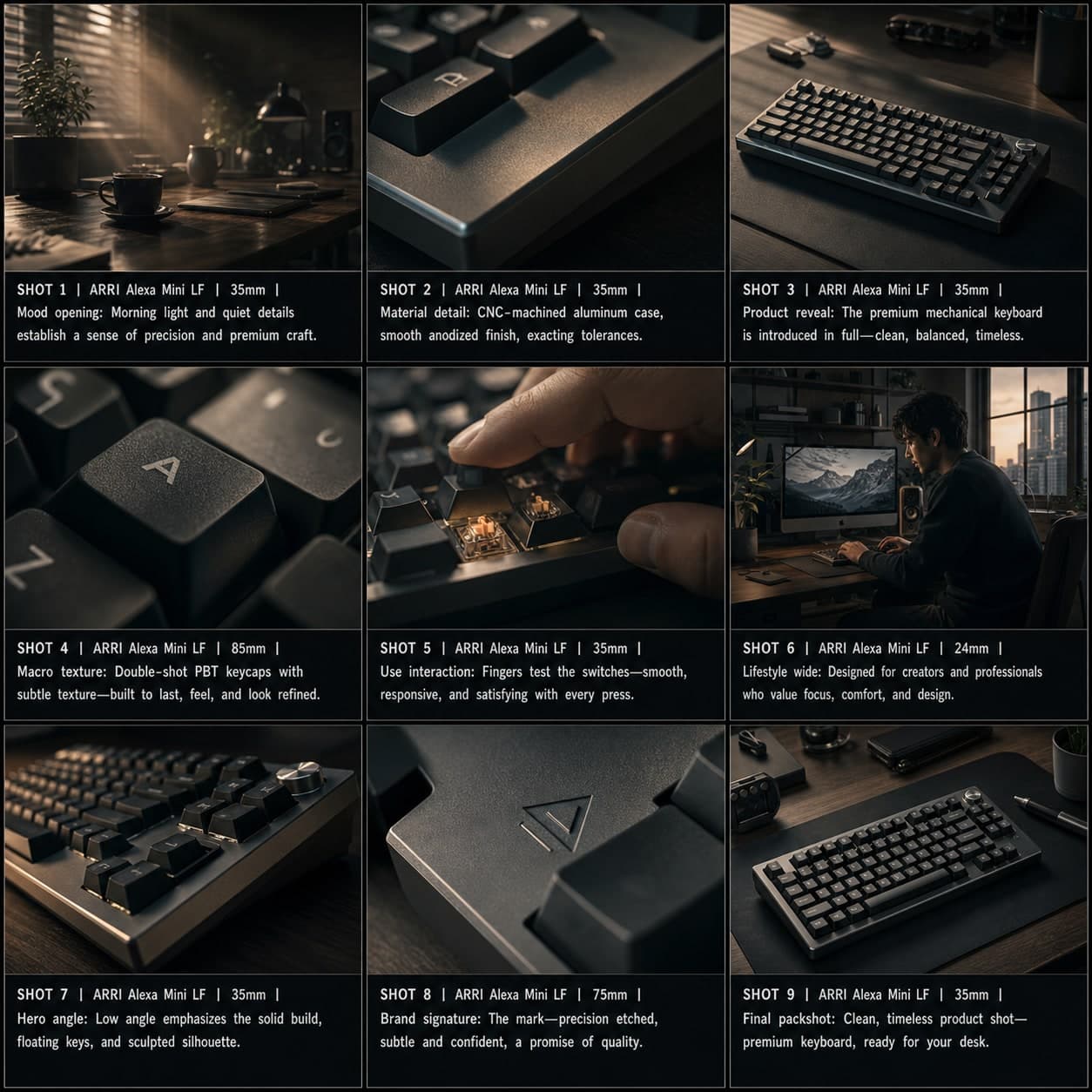
問題解決型 CM ストーリーボードテンプレート
フックからデモ、証拠、CTA まで、製品を問題の解決策として提示する 9 コマ CM シーケンス。
このテンプレートの用途
製品やサービスを明確な問題の解決策として提示する。
こんなときに使う
こんな用途に
- 商品広告
- サービス CM
- 問題解決型ナラティブ
9 コマシーケンス構成
| # | ショット | 目的 | カメラ |
|---|---|---|---|
| 01 | フックまたは問題シーン | すぐに問題を見せる | ワイド / アテンションフレーム |
| 02 | ペインポイントのクローズアップ | 苦痛を可視化する | クローズアップ |
| 03 | 旧来の失敗した方法 | 現在の方法の失敗を見せる | ミディアム |
| 04 | 商品お披露目 | ソリューションを導入する | プロダクトヒーローショット |
| 05 | 使用中の商品 | 使い方を見せる | デモンストレーションショット |
| 06 | 主要ベネフィット | メインの価値を視覚化する | ベネフィットクローズアップ |
| 07 | 証拠またはリアクション | ユーザーの信頼や結果を見せる | リアクションショット |
| 08 | ブランドモーメント | 記憶に残る画を作る | ヒーロー / ライフスタイルショット |
| 09 | CTAフレーム | アクションで終わる | パックショット / CTAフレーム |
01フックまたは問題シーン
すぐに問題を見せる
ワイド / アテンションフレーム
02ペインポイントのクローズアップ
苦痛を可視化する
クローズアップ
03旧来の失敗した方法
現在の方法の失敗を見せる
ミディアム
04商品お披露目
ソリューションを導入する
プロダクトヒーローショット
05使用中の商品
使い方を見せる
デモンストレーションショット
06主要ベネフィット
メインの価値を視覚化する
ベネフィットクローズアップ
07証拠またはリアクション
ユーザーの信頼や結果を見せる
リアクションショット
08ブランドモーメント
記憶に残る画を作る
ヒーロー / ライフスタイルショット
09CTAフレーム
アクションで終わる
パックショット / CTAフレーム
あなたのストーリー
シーンやストーリーを一文で書いてください。下の Prompt がリアルタイムで更新されます。空欄のままだとサンプルストーリーが使われます。
Prompt プレビュー
Create a square 3x3 2048x2048 storyboard grid as a cinematic storyboard infographic showing present a product or service as the solution to a clear problem: A remote worker loses focus in a chaotic apartment until a compact desk organizer turns the mess into a calm work zone. The sequence makes the pain visible, reveals the product, demonstrates use, and ends on a credible before/after payoff.

Use dark moody high-end film stills, realistic lighting, subtle teal-and-amber color grade, shallow depth of field, atmospheric dust and shadows. Maintain consistent subject identity, wardrobe, location type, visual medium, lighting, and color palette across all panels. If a reference image is provided, use it as the visual anchor for the subject, world, and style; if no reference image is provided, synthesize one coherent world from the story.

Plan the 9 storyboard panels yourself from the story and the template rhythm, then render the final infographic. Story facts must not change: preserve the named relationship, setting, key object, reveal, cause, and emotional meaning from the story. Do not replace the story's key object with a different document, incident, crime, accident, or backstory.

Arrange the storyboard in a clean 3x3 grid with thin black borders. Each tile must have a large crop-safe cinematic image area and a separate dark information strip below it. The image area must contain no text, labels, captions, UI, watermarks, or typography. Put all written information only in the strip below each image.

Sequence rhythm: Hook → pain → failure → product reveal → demo → benefit → proof → brand → CTA

Use this template structure as the shot grammar, but adapt every panel to the concrete story:
1. Hook or problem scene (top-left) — Wide / attention frame, 24mm. Purpose: Show the problem immediately. Suggested strip pattern: "SHOT 1 | ARRI Alexa Mini LF | 24mm | [write the concrete story beat you plan for this panel]"
2. Pain point close-up (top-center) — Close-up, 75mm. Purpose: Make the pain visible. Suggested strip pattern: "SHOT 2 | ARRI Alexa Mini LF | 75mm | [write the concrete story beat you plan for this panel]"
3. Failed old way (top-right) — Medium, 35mm. Purpose: Show current method failing. Suggested strip pattern: "SHOT 3 | ARRI Alexa Mini LF | 35mm | [write the concrete story beat you plan for this panel]"
4. Product reveal (middle-left) — Product hero shot, 35mm. Purpose: Introduce the solution. Suggested strip pattern: "SHOT 4 | ARRI Alexa Mini LF | 35mm | [write the concrete story beat you plan for this panel]"
5. Product in use (center) — Demonstration shot, 35mm. Purpose: Show how it works. Suggested strip pattern: "SHOT 5 | ARRI Alexa Mini LF | 35mm | [write the concrete story beat you plan for this panel]"
6. Key benefit (middle-right) — Benefit close-up, 75mm. Purpose: Visualize the main value. Suggested strip pattern: "SHOT 6 | ARRI Alexa Mini LF | 75mm | [write the concrete story beat you plan for this panel]"
7. Proof or reaction (bottom-left) — Reaction shot, 35mm. Purpose: Show user trust or result. Suggested strip pattern: "SHOT 7 | ARRI Alexa Mini LF | 35mm | [write the concrete story beat you plan for this panel]"
8. Brand moment (bottom-center) — Hero / lifestyle shot, 35mm. Purpose: Create memory image. Suggested strip pattern: "SHOT 8 | ARRI Alexa Mini LF | 35mm | [write the concrete story beat you plan for this panel]"
9. CTA frame (bottom-right) — Packshot / CTA frame, 35mm. Purpose: End with action. Suggested strip pattern: "SHOT 9 | ARRI Alexa Mini LF | 35mm | [write the concrete story beat you plan for this panel]"

Each information strip must show the planned panel title, shot metadata, and the concrete story beat in plain English. The strip text must include the story's key object and reveal where relevant, so the sequence cannot be mistaken for a different incident. Use clear numbered scene titles, compact metadata, and concise action subtitles in the information strips. Use plain text only: no emojis, no decorative symbols, no fake app UI text, and no real brand logos or copyrighted marks. Make each panel visually distinct through shot scale, camera angle, lens feeling, blocking, foreground/background layering, and subject movement. Exactly 9 panels, no extra panels, no merged panels, no duplicate compositions, no speech bubbles, no lorem ipsum, high-detail professional storyboard sheet.
Prompt をコピーして、リファレンス画像と一緒に ChatGPT に貼り付けるとストーリーボードシートが生成されます。 chatgpt.com →