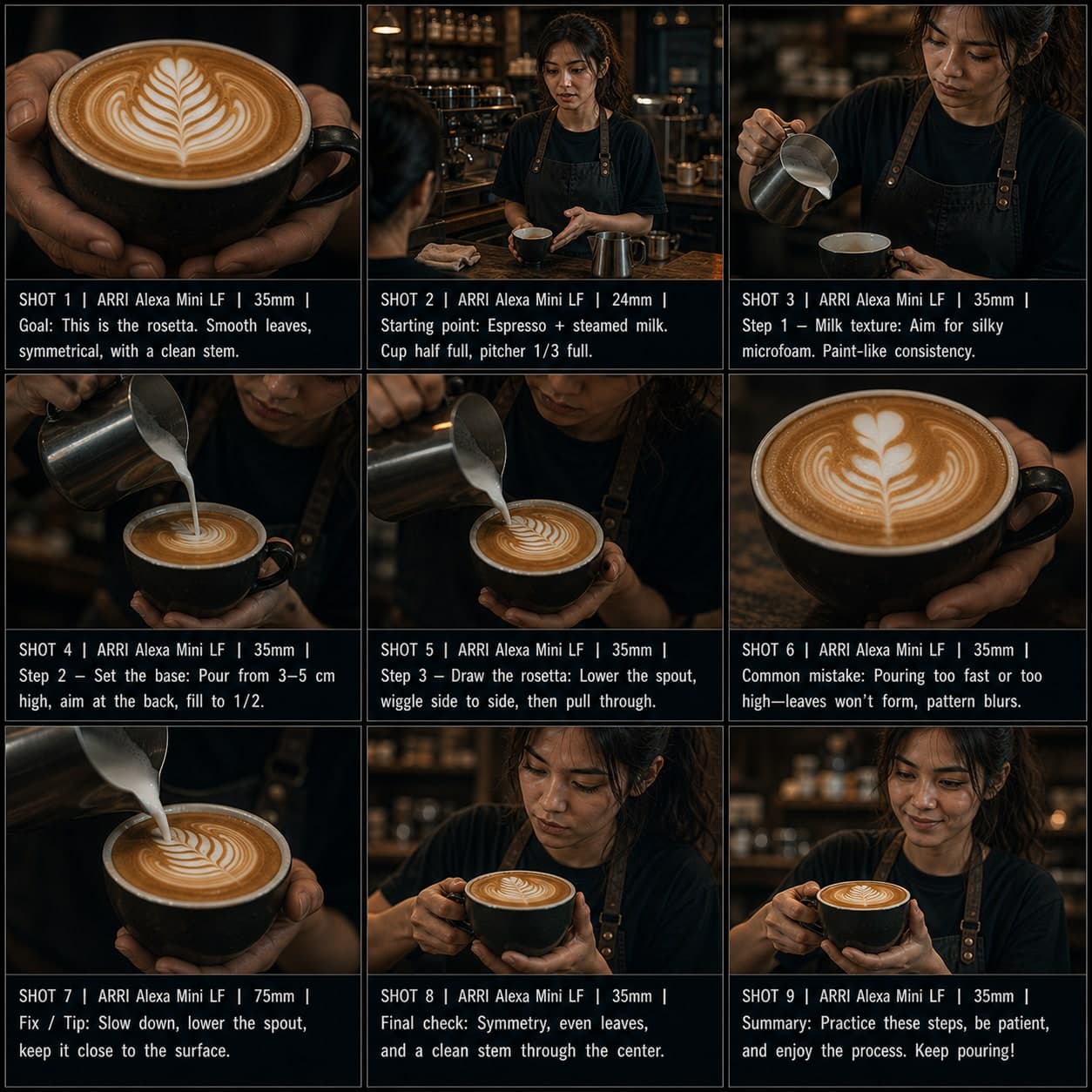
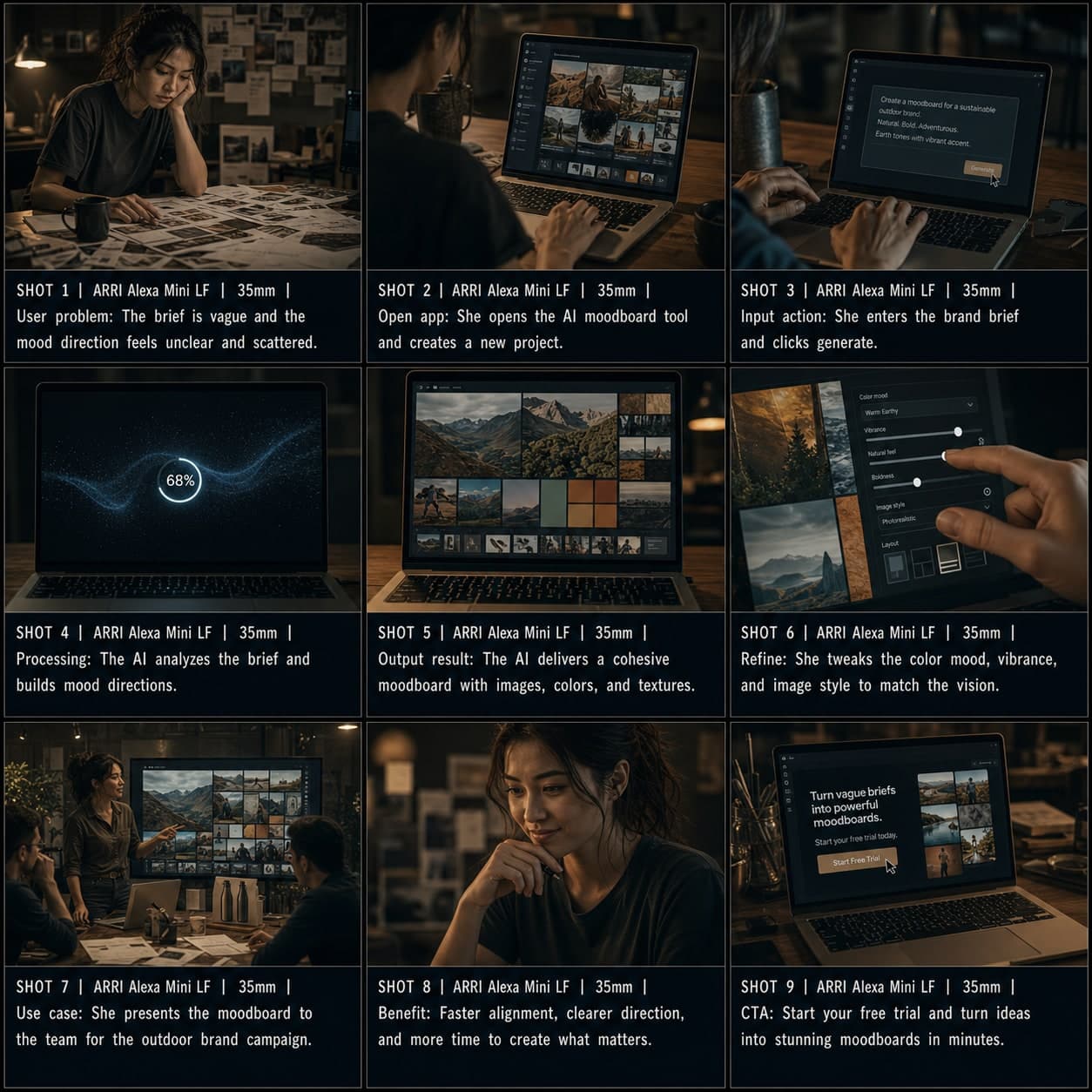
ファイブショット・プロセス ストーリーボードテンプレート
成果、手元、顔、文脈、ディテールの基本カバレッジで「誰かが何かを作る」を撮る 9 コマシーケンス。
このテンプレートの用途
基本的なビジュアルカバレッジで「誰かが何かをする」を見せる。
こんなときに使う
こんな用途に
- 制作過程の記録
- クラフト紹介
- メイカーコンテンツ
9 コマシーケンス構成
| # | ショット | 目的 | カメラ |
|---|---|---|---|
| 01 | 完成品プレビュー | 何が作られるかを見せる | リザルトショット |
| 02 | 手元クローズアップ | 何をしているかを見せる | ハンズクローズアップ |
| 03 | 顔または被写体クローズアップ | 誰がやっているかを見せる | クローズアップ |
| 04 | ワイドコンテキスト | どこで行われているかを見せる | ワイド |
| 05 | オーバーショルダー | どうやっているかを見せる | OTS |
| 06 | キーディテールステップ | 重要な細部を見せる | インサート |
| 07 | 問題または修正 | 困難や調整を見せる | ミディアム / クローズ |
| 08 | 完了アクション | 仕上げのアクションを見せる | アクションショット |
| 09 | 最終結果 | 完成した成果を見せる | リザルトフレーム |
01完成品プレビュー
何が作られるかを見せる
リザルトショット
02手元クローズアップ
何をしているかを見せる
ハンズクローズアップ
03顔または被写体クローズアップ
誰がやっているかを見せる
クローズアップ
04ワイドコンテキスト
どこで行われているかを見せる
ワイド
05オーバーショルダー
どうやっているかを見せる
OTS
06キーディテールステップ
重要な細部を見せる
インサート
07問題または修正
困難や調整を見せる
ミディアム / クローズ
08完了アクション
仕上げのアクションを見せる
アクションショット
09最終結果
完成した成果を見せる
リザルトフレーム
あなたのストーリー
シーンやストーリーを一文で書いてください。下の Prompt がリアルタイムで更新されます。空欄のままだとサンプルストーリーが使われます。
Prompt プレビュー
Create a square 3x3 2048x2048 storyboard grid as a cinematic storyboard infographic showing show someone doing something through essential visual coverage: A ceramic artist turns raw clay into a finished bowl. The sequence uses the classic process grammar: result preview, hands, face, workspace, over-the-shoulder action, key detail, correction, completion, and final object.

Use dark moody high-end film stills, realistic lighting, subtle teal-and-amber color grade, shallow depth of field, atmospheric dust and shadows. Maintain consistent subject identity, wardrobe, location type, visual medium, lighting, and color palette across all panels. If a reference image is provided, use it as the visual anchor for the subject, world, and style; if no reference image is provided, synthesize one coherent world from the story.

Plan the 9 storyboard panels yourself from the story and the template rhythm, then render the final infographic. Story facts must not change: preserve the named relationship, setting, key object, reveal, cause, and emotional meaning from the story. Do not replace the story's key object with a different document, incident, crime, accident, or backstory.

Arrange the storyboard in a clean 3x3 grid with thin black borders. Each tile must have a large crop-safe cinematic image area and a separate dark information strip below it. The image area must contain no text, labels, captions, UI, watermarks, or typography. Put all written information only in the strip below each image.

Sequence rhythm: Result preview → hands → face → wide context → OTS → detail → correction → completion → final result

Use this template structure as the shot grammar, but adapt every panel to the concrete story:
1. Result preview (top-left) — Result shot, 35mm. Purpose: Show what will be made or achieved. Suggested strip pattern: "SHOT 1 | ARRI Alexa Mini LF | 35mm | [write the concrete story beat you plan for this panel]"
2. Hands close-up (top-center) — Hands close-up, 75mm. Purpose: Show what is being done. Suggested strip pattern: "SHOT 2 | ARRI Alexa Mini LF | 75mm | [write the concrete story beat you plan for this panel]"
3. Face or subject close-up (top-right) — Close-up, 75mm. Purpose: Show who is doing it. Suggested strip pattern: "SHOT 3 | ARRI Alexa Mini LF | 75mm | [write the concrete story beat you plan for this panel]"
4. Wide context (middle-left) — Wide, 24mm. Purpose: Show where it happens. Suggested strip pattern: "SHOT 4 | ARRI Alexa Mini LF | 24mm | [write the concrete story beat you plan for this panel]"
5. Over-the-shoulder (center) — OTS, 50mm. Purpose: Show how it is done. Suggested strip pattern: "SHOT 5 | ARRI Alexa Mini LF | 50mm | [write the concrete story beat you plan for this panel]"
6. Key detail step (middle-right) — Insert, 85mm. Purpose: Show crucial detail. Suggested strip pattern: "SHOT 6 | ARRI Alexa Mini LF | 85mm | [write the concrete story beat you plan for this panel]"
7. Problem or correction (bottom-left) — Medium / close, 35mm. Purpose: Show difficulty or adjustment. Suggested strip pattern: "SHOT 7 | ARRI Alexa Mini LF | 35mm | [write the concrete story beat you plan for this panel]"
8. Completion action (bottom-center) — Action shot, 35mm. Purpose: Show finishing action. Suggested strip pattern: "SHOT 8 | ARRI Alexa Mini LF | 35mm | [write the concrete story beat you plan for this panel]"
9. Final result (bottom-right) — Result frame, 35mm. Purpose: Show completed outcome. Suggested strip pattern: "SHOT 9 | ARRI Alexa Mini LF | 35mm | [write the concrete story beat you plan for this panel]"

Each information strip must show the planned panel title, shot metadata, and the concrete story beat in plain English. The strip text must include the story's key object and reveal where relevant, so the sequence cannot be mistaken for a different incident. Use clear numbered scene titles, compact metadata, and concise action subtitles in the information strips. Use plain text only: no emojis, no decorative symbols, no fake app UI text, and no real brand logos or copyrighted marks. Make each panel visually distinct through shot scale, camera angle, lens feeling, blocking, foreground/background layering, and subject movement. Exactly 9 panels, no extra panels, no merged panels, no duplicate compositions, no speech bubbles, no lorem ipsum, high-detail professional storyboard sheet.
Prompt をコピーして、リファレンス画像と一緒に ChatGPT に貼り付けるとストーリーボードシートが生成されます。 chatgpt.com →