Modello di storyboard Performance + Narrazione in alternanza
Alternare performance e filo narrativo semplice per video musicali con storia. Un modello di storyboard performance-narrativa per sequenze in alternanza.
A cosa serve questo modello
Alternare performance e filo narrativo semplice.
Quando usarlo
Ideale per
- video musicali con storia
- performance + narrazione
- sequenze in alternanza
Struttura di sequenza a 9 pannelli
| # | Inquadratura | Scopo | Camera |
|---|---|---|---|
| 01 | Stabilizzazione della performance | Mostrare l'interprete o il palco | Campo lungo |
| 02 | Setup narrativo | Introdurre il filo narrativo | Configurazione di scena |
| 03 | Primo piano performance | Creare intimità | Primo piano |
| 04 | Dettaglio narrativo | Aggiungere un indizio narrativo | Insert |
| 05 | Taglio ritmico | Cambiare l'energia | Piano dinamico |
| 06 | Beat emotivo narrativo | Ancorare l'emozione narrativa | Reazione |
| 07 | Picco della performance | Raggiungere il climax musicale | Performance eroica |
| 08 | Risoluzione narrativa | Risolvere il filo narrativo | Piano medio / campo lungo |
| 09 | Piano iconico finale | Chiudere con un'immagine che resta | Piano finale iconico |
Mostrare l'interprete o il palco
Introdurre il filo narrativo
Creare intimità
Aggiungere un indizio narrativo
Cambiare l'energia
Ancorare l'emozione narrativa
Raggiungere il climax musicale
Risolvere il filo narrativo
Chiudere con un'immagine che resta
La tua storia
Descrivi la tua scena o storia in una frase. Il prompt sottostante si aggiorna in tempo reale. Lascia vuoto per usare l'esempio.
Anteprima Prompt
Create a square 3x3 2048x2048 storyboard grid as a cinematic storyboard infographic showing intercut performance with a simple narrative thread: A drummer performs alone in a rehearsal studio while a parallel thread shows the band breaking up earlier that night. Performance shots and narrative fragments intercut until the final hit turns into a quiet resolution.

Use dark moody high-end film stills, realistic lighting, subtle teal-and-amber color grade, shallow depth of field, atmospheric dust and shadows. Maintain consistent subject identity, wardrobe, location type, visual medium, lighting, and color palette across all panels. If a reference image is provided, use it as the visual anchor for the subject, world, and style; if no reference image is provided, synthesize one coherent world from the story.

Plan the 9 storyboard panels yourself from the story and the template rhythm, then render the final infographic. Story facts must not change: preserve the named relationship, setting, key object, reveal, cause, and emotional meaning from the story. Do not replace the story's key object with a different document, incident, crime, accident, or backstory.

Arrange the storyboard in a clean 3x3 grid with thin black borders. Each tile must have a large crop-safe cinematic image area and a separate dark information strip below it. The image area must contain no text, labels, captions, UI, watermarks, or typography. Put all written information only in the strip below each image.

Sequence rhythm: Performance wide → narrative setup → performance CU → narrative detail → rhythm → emotion → peak → resolution → iconic

Use this template structure as the shot grammar, but adapt every panel to the concrete story:
1. Performance establishing (top-left) — Wide, 24mm. Purpose: Show performer or stage. Suggested strip pattern: "SHOT 1 | ARRI Alexa Mini LF | 24mm | [write the concrete story beat you plan for this panel]"
2. Narrative setup (top-center) — Scene setup, 35mm. Purpose: Introduce story thread. Suggested strip pattern: "SHOT 2 | ARRI Alexa Mini LF | 35mm | [write the concrete story beat you plan for this panel]"
3. Performance close-up (top-right) — Close-up, 75mm. Purpose: Bring intimacy. Suggested strip pattern: "SHOT 3 | ARRI Alexa Mini LF | 75mm | [write the concrete story beat you plan for this panel]"
4. Narrative detail (middle-left) — Insert, 85mm. Purpose: Add story clue. Suggested strip pattern: "SHOT 4 | ARRI Alexa Mini LF | 85mm | [write the concrete story beat you plan for this panel]"
5. Rhythm cut (center) — Dynamic shot, 35mm. Purpose: Switch energy. Suggested strip pattern: "SHOT 5 | ARRI Alexa Mini LF | 35mm | [write the concrete story beat you plan for this panel]"
6. Emotional narrative beat (middle-right) — Reaction, 35mm. Purpose: Land story emotion. Suggested strip pattern: "SHOT 6 | ARRI Alexa Mini LF | 35mm | [write the concrete story beat you plan for this panel]"
7. Performance peak (bottom-left) — Hero performance, 35mm. Purpose: Hit musical climax. Suggested strip pattern: "SHOT 7 | ARRI Alexa Mini LF | 35mm | [write the concrete story beat you plan for this panel]"
8. Narrative resolution (bottom-center) — Medium / wide, 24mm. Purpose: Resolve story thread. Suggested strip pattern: "SHOT 8 | ARRI Alexa Mini LF | 24mm | [write the concrete story beat you plan for this panel]"
9. Final iconic frame (bottom-right) — Iconic final, 35mm. Purpose: End with image that holds. Suggested strip pattern: "SHOT 9 | ARRI Alexa Mini LF | 35mm | [write the concrete story beat you plan for this panel]"

Each information strip must show the planned panel title, shot metadata, and the concrete story beat in plain English. The strip text must include the story's key object and reveal where relevant, so the sequence cannot be mistaken for a different incident. Use clear numbered scene titles, compact metadata, and concise action subtitles in the information strips. Use plain text only: no emojis, no decorative symbols, no fake app UI text, and no real brand logos or copyrighted marks. Make each panel visually distinct through shot scale, camera angle, lens feeling, blocking, foreground/background layering, and subject movement. Exactly 9 panels, no extra panels, no merged panels, no duplicate compositions, no speech bubbles, no lorem ipsum, high-detail professional storyboard sheet.
Copia il prompt e incollalo in ChatGPT insieme alla tua immagine di riferimento per generare uno storyboard. chatgpt.com →
Modelli correlati
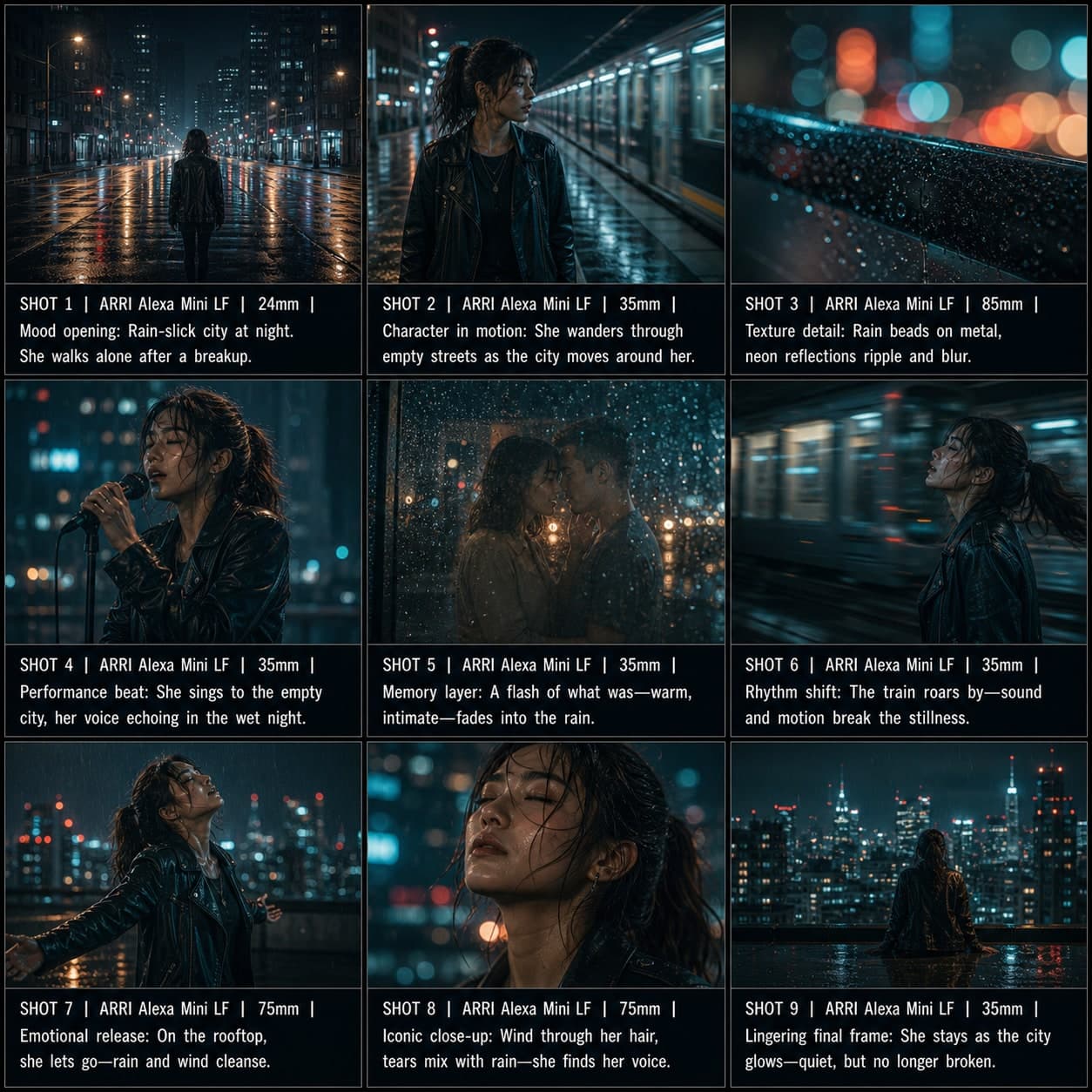 3×3
3×3Modello di storyboard Montaggio d'atmosfera video musicale
Costruire un ritmo visivo guidato dall'atmosfera con ambiente, texture e rilascio emotivo. Un modello di storyboard di video musicale per sequenze di montaggio d'atmosfera.
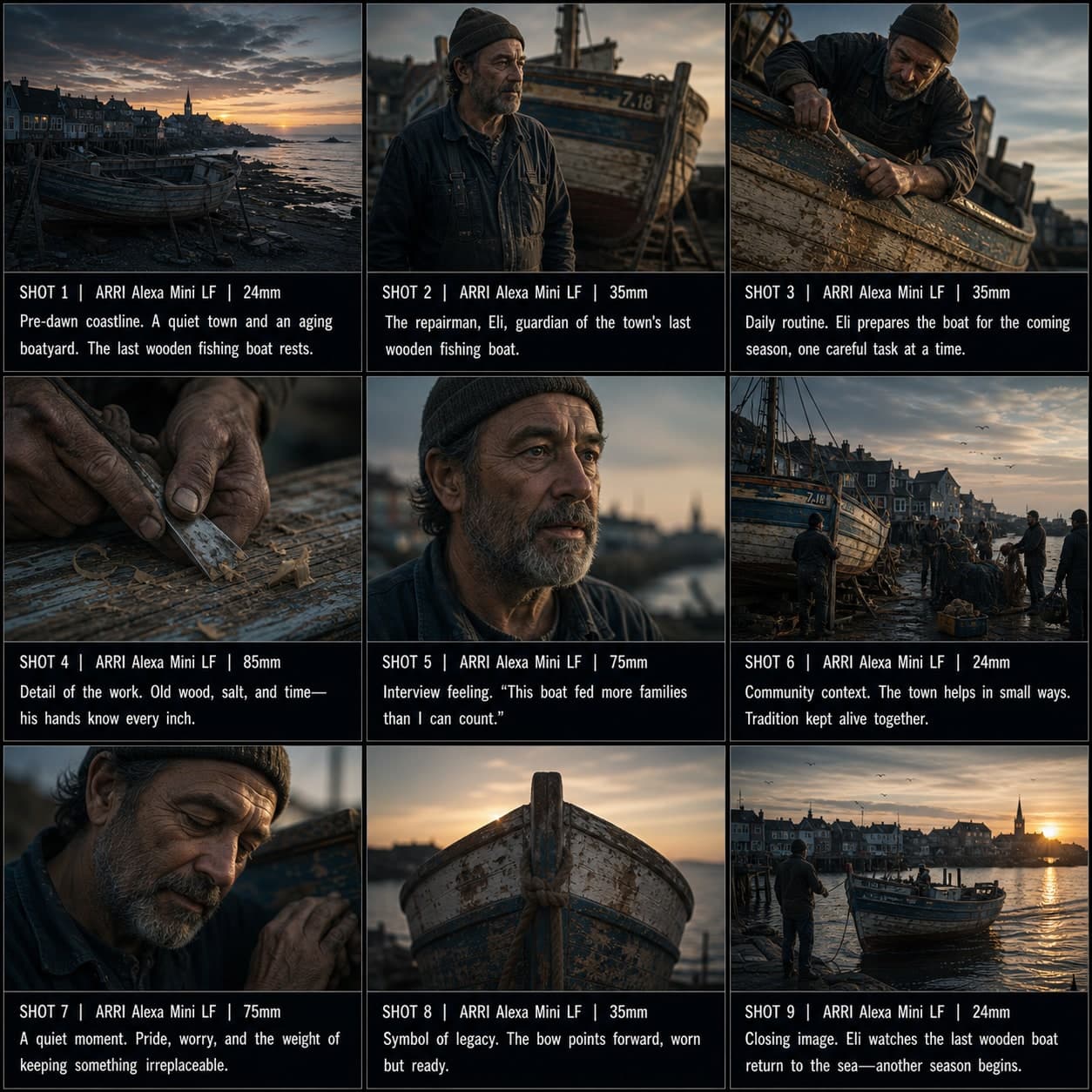 3×3
3×3Modello di storyboard Momento documentario
Catturare una persona, un luogo o un momento reale con ritmo osservativo e risonanza quieta. Un modello di storyboard documentario per scene di cinema osservativo.