Modèle de storyboard Démo App / SaaS
Démontrer un workflow logiciel ou outil IA du problème à l'entrée, la sortie et le CTA. Un modèle de storyboard de démo app pour les vidéos de présentation SaaS.
À quoi sert ce modèle
Démontrer un workflow logiciel ou outil IA.
Quand l'utiliser
Idéal pour
- démos d'applications
- présentations SaaS
- démonstrations d'outils IA
Structure de séquence à 9 panneaux
| # | Plan | Objectif | Caméra |
|---|---|---|---|
| 01 | Problème utilisateur | Montrer le problème | Scène identifiable |
| 02 | Ouverture de l'app ou interface | Introduire l'environnement produit | Plan interface |
| 03 | Action de saisie | L'utilisateur entre quelque chose | Plan interaction |
| 04 | Traitement ou moment magique | Montrer le système en action | Plan processus |
| 05 | Résultat de sortie | Montrer le résultat | Plan résultat |
| 06 | Modifier ou affiner | Montrer le contrôle | Plan affinement |
| 07 | Cas d'usage | Montrer le résultat en contexte | Plan contexte |
| 08 | Bénéfice | Montrer la valeur | Plan bénéfice |
| 09 | CTA | Inviter à l'essai ou à l'inscription | Plan CTA |
Montrer le problème
Introduire l'environnement produit
L'utilisateur entre quelque chose
Montrer le système en action
Montrer le résultat
Montrer le contrôle
Montrer le résultat en contexte
Montrer la valeur
Inviter à l'essai ou à l'inscription
Votre histoire
Décrivez votre scène ou histoire en une phrase. Le prompt ci-dessous se met à jour en temps réel. Laissez vide pour utiliser l'exemple.
Aperçu du Prompt
Create a square 3x3 2048x2048 storyboard grid as a cinematic storyboard infographic showing demonstrate a software or ai tool workflow: A designer uses an AI moodboard tool to turn a vague brand brief into a presentation-ready direction. The sequence shows user problem, interface, input, processing, output, refinement, real use case, benefit, and CTA.

Use dark moody high-end film stills, realistic lighting, subtle teal-and-amber color grade, shallow depth of field, atmospheric dust and shadows. Maintain consistent subject identity, wardrobe, location type, visual medium, lighting, and color palette across all panels. If a reference image is provided, use it as the visual anchor for the subject, world, and style; if no reference image is provided, synthesize one coherent world from the story.

Plan the 9 storyboard panels yourself from the story and the template rhythm, then render the final infographic. Story facts must not change: preserve the named relationship, setting, key object, reveal, cause, and emotional meaning from the story. Do not replace the story's key object with a different document, incident, crime, accident, or backstory.

Arrange the storyboard in a clean 3x3 grid with thin black borders. Each tile must have a large crop-safe cinematic image area and a separate dark information strip below it. The image area must contain no text, labels, captions, UI, watermarks, or typography. Put all written information only in the strip below each image.

Sequence rhythm: User problem → open app → input → processing → output → refine → use case → benefit → CTA

Use this template structure as the shot grammar, but adapt every panel to the concrete story:
1. User problem (top-left) — Relatable scene, 35mm. Purpose: Show the problem. Suggested strip pattern: "SHOT 1 | ARRI Alexa Mini LF | 35mm | [write the concrete story beat you plan for this panel]"
2. Open app or interface (top-center) — Interface shot, 35mm. Purpose: Introduce product environment. Suggested strip pattern: "SHOT 2 | ARRI Alexa Mini LF | 35mm | [write the concrete story beat you plan for this panel]"
3. Input action (top-right) — Interaction shot, 35mm. Purpose: User enters something. Suggested strip pattern: "SHOT 3 | ARRI Alexa Mini LF | 35mm | [write the concrete story beat you plan for this panel]"
4. Processing or magic moment (middle-left) — Process frame, 35mm. Purpose: Show system working. Suggested strip pattern: "SHOT 4 | ARRI Alexa Mini LF | 35mm | [write the concrete story beat you plan for this panel]"
5. Output result (center) — Output frame, 35mm. Purpose: Show result. Suggested strip pattern: "SHOT 5 | ARRI Alexa Mini LF | 35mm | [write the concrete story beat you plan for this panel]"
6. Edit or refine (middle-right) — Refinement frame, 35mm. Purpose: Show control. Suggested strip pattern: "SHOT 6 | ARRI Alexa Mini LF | 35mm | [write the concrete story beat you plan for this panel]"
7. Use case (bottom-left) — Context shot, 35mm. Purpose: Show result in context. Suggested strip pattern: "SHOT 7 | ARRI Alexa Mini LF | 35mm | [write the concrete story beat you plan for this panel]"
8. Benefit (bottom-center) — Benefit frame, 35mm. Purpose: Show value. Suggested strip pattern: "SHOT 8 | ARRI Alexa Mini LF | 35mm | [write the concrete story beat you plan for this panel]"
9. CTA (bottom-right) — CTA frame, 35mm. Purpose: Invite trial or signup. Suggested strip pattern: "SHOT 9 | ARRI Alexa Mini LF | 35mm | [write the concrete story beat you plan for this panel]"

Each information strip must show the planned panel title, shot metadata, and the concrete story beat in plain English. The strip text must include the story's key object and reveal where relevant, so the sequence cannot be mistaken for a different incident. Use clear numbered scene titles, compact metadata, and concise action subtitles in the information strips. Use plain text only: no emojis, no decorative symbols, no fake app UI text, and no real brand logos or copyrighted marks. Make each panel visually distinct through shot scale, camera angle, lens feeling, blocking, foreground/background layering, and subject movement. Exactly 9 panels, no extra panels, no merged panels, no duplicate compositions, no speech bubbles, no lorem ipsum, high-detail professional storyboard sheet.
Copiez le prompt et collez-le dans ChatGPT avec votre image de référence pour générer un storyboard. chatgpt.com →
Modèles similaires
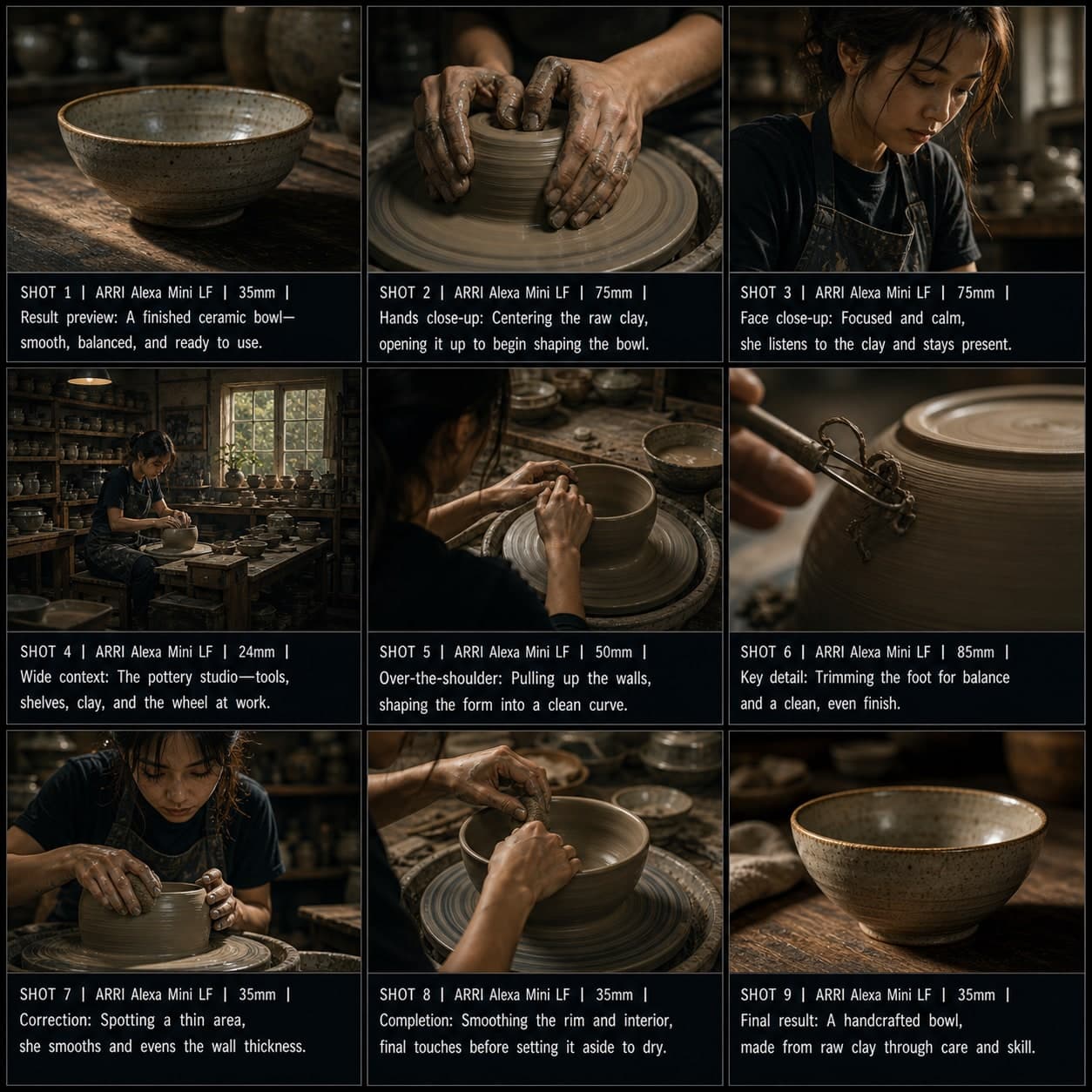 3×3
3×3Modèle de storyboard Processus en cinq plans
Montrer quelqu'un en train de faire quelque chose à travers une couverture visuelle essentielle — résultat, mains, visage, contexte, détail. Un modèle de storyboard de processus pour les créateurs.
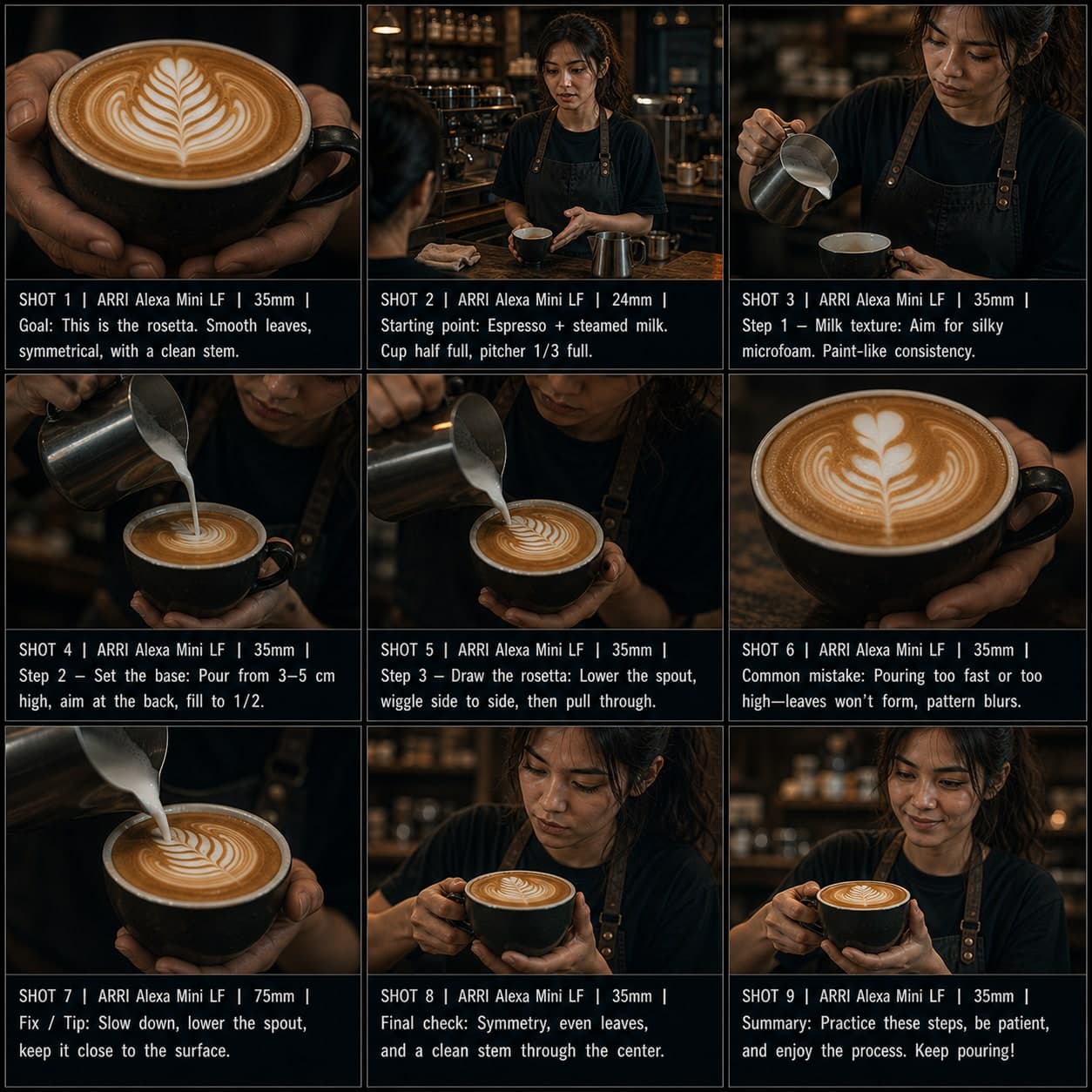 3×3
3×3Modèle de storyboard Tutoriel étape par étape
Expliquer un processus en étapes ordonnées avec erreurs courantes, corrections et vérification finale. Un modèle de storyboard tutoriel pour les vidéos explicatives.